Learn what every symbol on the card means.Full credits and sources at beakbrain.com/symbols
 ShrublandCup nestTiny · 6 g


ID tip
Hispaniolan mangoes are 11.5 to 13.5 cm (4.5 to 5.3 in) long; males weigh 6.0 to 8.2 g (0.21 to 0.29 oz) and females 4.0 to 7.0 g (0.14 to 0.25 oz). Adult males have shiny bronze-green upperparts. The chin and throat are metallic green and the rest of the underparts velvety black with a bluish tinge. The tail is mostly violet; the inner webs of the feathers are coppery and the tips blue-black. The female's upperparts are also shiny bronze-green. Its underparts are grayish lightening to pale white on the abdomen. Voice: The Hispaniolan mango is thought to be mostly silent, and its song has not been described. The calls include "a repeated short tsip" and "a high-pitched liquid trill".
Text from Wikipedia, licensed CC BY-SA 4.0.
When to see the Hispaniolan Mango
One bar for each month, and every month is filled: this bird is recorded here in all twelve. The wide bar is January, the month with the most records.
Where to see the Hispaniolan Mango
The map shades 5 countries with regular records. Everything unshaded has no records. Countries are listed below the map.
About the Hispaniolan Mango
The Hispaniolan mango is a species of hummingbird in the subfamily Polytminae. It is endemic to the Caribbean island of Hispaniola.
Text adapted from Wikipedia, licensed CC BY-SA 4.0.
Easily confused with
 Green MangoAnthracothorax viridisThe green mango is 11 to 14 cm (4.3 to 5.5 in) long and weighs about 7 g (0.25 oz).
 Jamaican MangoAnthracothorax mangoThe Jamaican mango is 11 to 12 cm (4.3 to 4.7 in) long and weighs 8.5 to 9.1 g (0.30 to 0.32 oz).
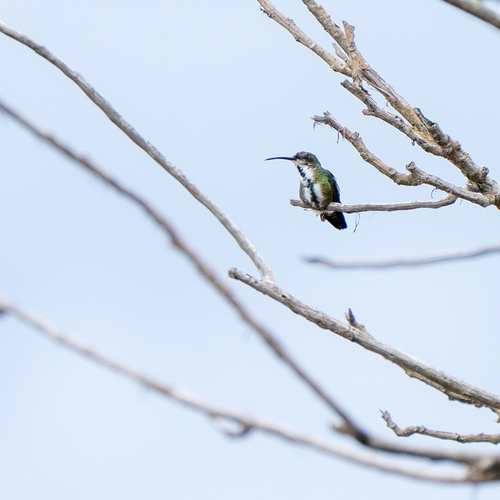 Veraguan MangoAnthracothorax veraguensisThe Veraguan mango is a medium-sized hummingbird species, reaching lengths of 11–12 cm.
Side by side: Black-throated Mango vs Hispaniolan Mango · Green-breasted Mango vs Hispaniolan Mango · Green Mango vs Hispaniolan Mango · Hispaniolan Mango vs Jamaican Mango
Learn the Hispaniolan Mango in the BeakBrain App
Photo and call practice. Coming soon to iPhone and Android.
Play today's Daily BirdEvery photo and recording on this page is credited to its author under the licence shown. Spotted a problem with this page, or have a better photo? Contribute.