Learn what every symbol on the card means.Full credits and sources at beakbrain.com/symbols
 ShrublandCup nestTiny · 7 g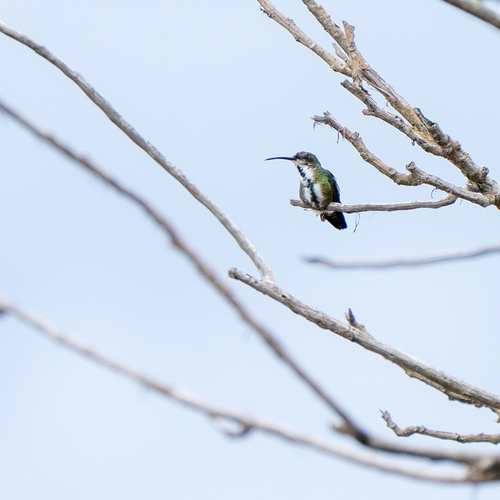
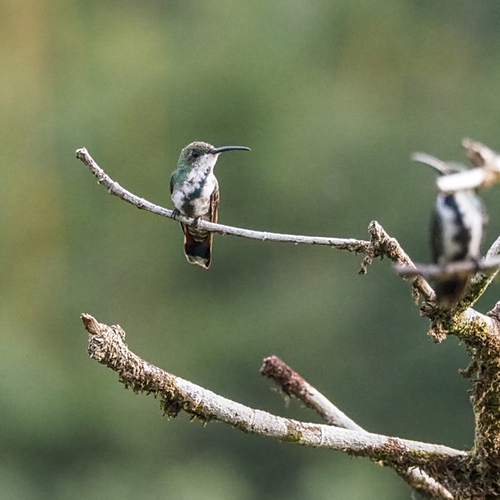
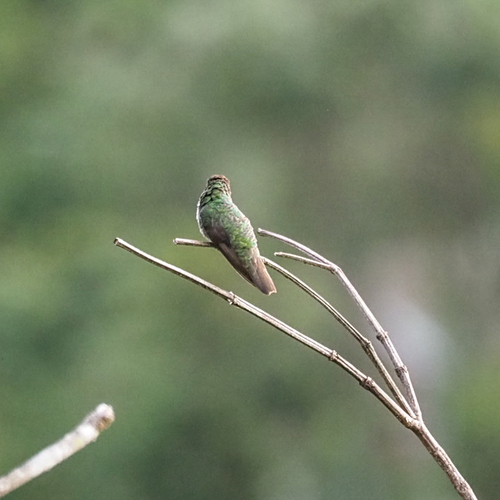

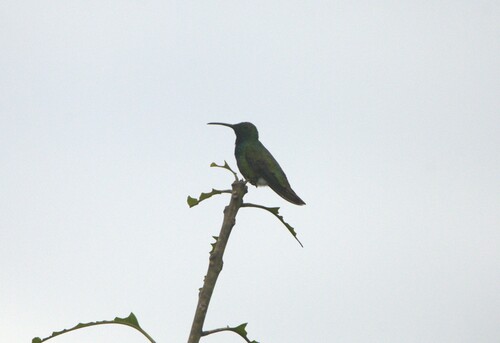
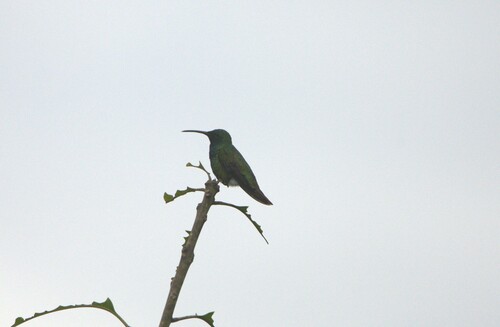
ID tip
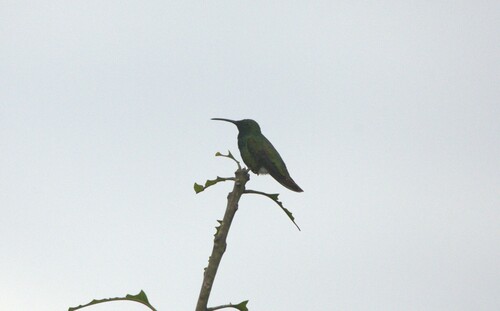
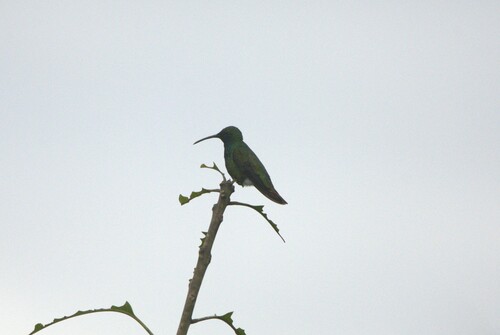
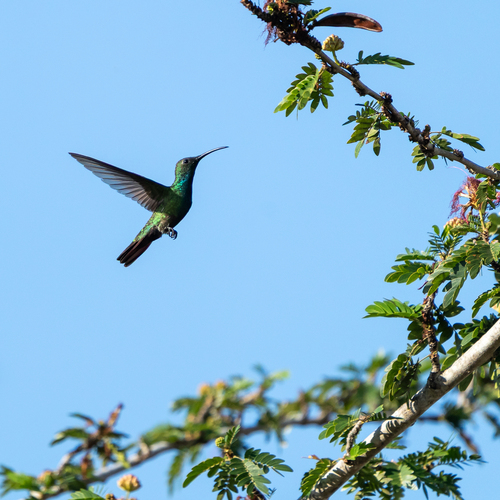
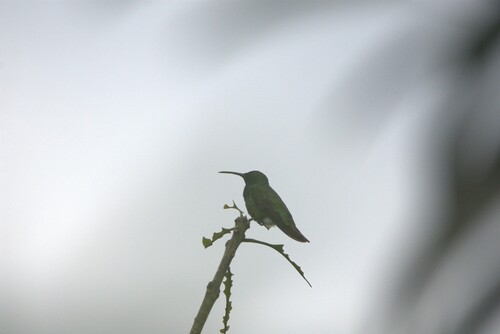
The Veraguan mango is a medium-sized hummingbird species, reaching lengths of 11–12 cm. Both sexes are metallic green with a slightly decurved, dark grey beak, and black tail feathers with a red circle central to each feather. This species exhibits sexual dimorphism. Males have a blueish breast and belly, whilst females have a white-cream belly with a dark teal stripe running down the breast. The morphology of the Veraguan mango is very similar to that of the Green-breasted mango, however it differs by the lack of black plumage on the throat.
Text from Wikipedia, licensed CC BY-SA 4.0.
When to see the Veraguan Mango
One bar for each month. Filled bars are the 9 months with records; pale bars are months with none. The wide bar is January, the month with the most records.
Where to see the Veraguan Mango
The map shades 2 countries with regular records. Everything unshaded has no records. Countries are listed below the map.
About the Veraguan Mango
The Veraguan mango is a species of hummingbird in the family Trochilidae. It is found in Panama and recently in Costa Rica. It was considered conspecific with the Green-breasted Mango but was separated due to morphological and geographical differences in 1995.
Text adapted from Wikipedia, licensed CC BY-SA 4.0.
Easily confused with
 Green-throated MangoAnthracothorax viridigulaThe green-throated mango is 10.5 to 12.5 cm (4.1 to 4.9 in) long.
 Jamaican MangoAnthracothorax mangoThe Jamaican mango is 11 to 12 cm (4.3 to 4.7 in) long and weighs 8.5 to 9.1 g (0.30 to 0.32 oz).
 Puerto Rican MangoAnthracothorax aurulentusThe Puerto Rican mango is 11 to 12 cm (4.3 to 4.7 in) long; males weigh 4.8 to 7.2 g (0.17 to 0.25 oz) and females 4.0 to 6.4 g (0.14 to 0.23 oz).
Learn the Veraguan Mango in the BeakBrain App
Photo and call practice. Coming soon to iPhone and Android.
Play today's Daily BirdEvery photo and recording on this page is credited to its author under the licence shown. Spotted a problem with this page, or have a better photo? Contribute.