Learn what every symbol on the card means.Full credits and sources at beakbrain.com/symbols
 ForestCup nestTiny · 7 g


ID tip
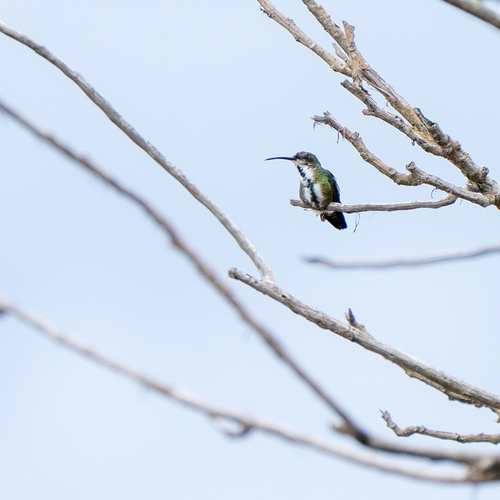
The green mango is 11 to 14 cm (4.3 to 5.5 in) long and weighs about 7 g (0.25 oz). The sexes are alike except that the female has a tiny white spot behind the eye. Adults' upperparts are emerald green, their underparts metallic blue-green, and their tail metallic blue-black with white tips to its feathers. Immatures have a brownish tinge to the head and back. Voice: The green mango is not highly vocal. It does have a song, "a repeated high-pitched phrase commencing with a drawn-out buzz, 'szzzzz-szi-szi-chup-tsz-tsz.....'." Its calls include "a repeated short 'tsik' and a high-pitched twittering trill." It makes harsh rattles and chatters during agonistic encounters.
Text from Wikipedia, licensed CC BY-SA 4.0.
When to see the Green Mango
One bar for each month. Filled bars are the 11 months with records; pale bars are months with none. The wide bar is February, the month with the most records.
Where to see the Green Mango
The map shades 1 country with regular records. Everything unshaded has no records. Countries are listed below the map.
About the Green Mango
The green mango, most commonly known in Spanish as zumbador verde and colibrí verde, is a large species of hummingbird in the subfamily Polytminae, endemic to the main island of Puerto Rico.
Text adapted from Wikipedia, licensed CC BY-SA 4.0.
Easily confused with
 Jamaican MangoAnthracothorax mangoThe Jamaican mango is 11 to 12 cm (4.3 to 4.7 in) long and weighs 8.5 to 9.1 g (0.30 to 0.32 oz).
 Veraguan MangoAnthracothorax veraguensisThe Veraguan mango is a medium-sized hummingbird species, reaching lengths of 11–12 cm.
 Green-throated MangoAnthracothorax viridigulaThe green-throated mango is 10.5 to 12.5 cm (4.1 to 4.9 in) long.
Side by side: Black-throated Mango vs Green Mango · Green-breasted Mango vs Green Mango · Green Mango vs Hispaniolan Mango · Green Mango vs Purple-collared Woodstar · Green Mango vs Jamaican Mango
Learn the Green Mango in the BeakBrain App
Photo and call practice. Coming soon to iPhone and Android.
Play today's Daily BirdEvery photo and recording on this page is credited to its author under the licence shown. Spotted a problem with this page, or have a better photo? Contribute.