Learn what every symbol on the card means.Full credits and sources at beakbrain.com/symbols
 CoastalPlatform nestMedium · 218 g


What the Gull-billed Tern sounds like


ID tip
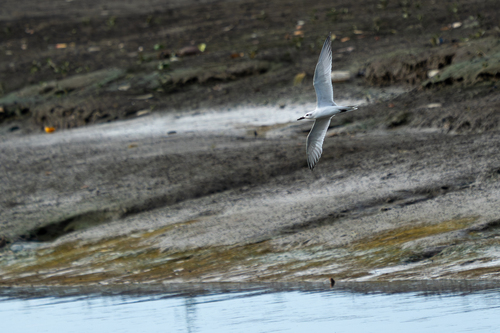
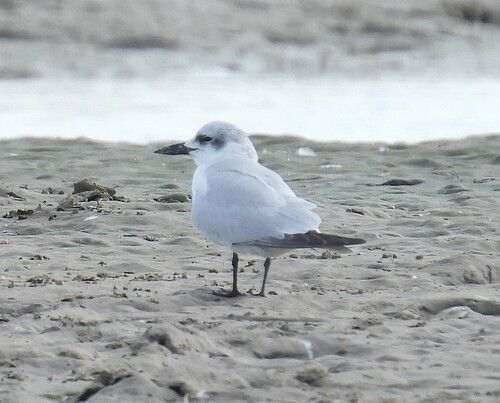
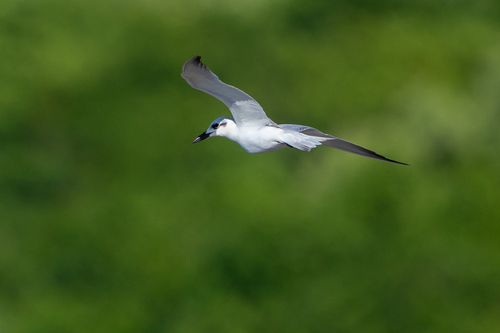
This is a fairly large and powerful tern, similar in size and general appearance to a Sandwich tern, but the short thick gull-like bill, broad wings, long legs and robust body are distinctive. The summer adult has grey upperparts, white underparts, a black cap, strong black bill and black legs. The call is a characteristic ker-wik. It is 33–42 cm (13–17 in) in length and 76–91 cm (30–36 in) in wingspan. Body mass ranges from 150–292 g (5.3–10.3 oz). In winter, the cap is lost, and there is a dark patch through the eye like a Forster's tern or a Mediterranean gull.
Text from Wikipedia, licensed CC BY-SA 4.0.
When to see the Gull-billed Tern
One bar for each month, and every month is filled: this bird is recorded here in all twelve. The wide bar is April, the month with the most records.
Where to see the Gull-billed Tern
The map shades 156 countries with regular records, and 14 more in a lighter tone where the bird turns up only as a stray. Everything unshaded has no records. Countries are listed below the map.
Recorded as a rare visitor in Canada, Finland, New Zealand, South Korea, Iceland, Benin, Gabon, Liberia, St. Barthélemy, Gibraltar, St. Kitts & Nevis, Czechia, North Macedonia, Guam.
About the Gull-billed Tern
The gull-billed tern is a tern in the family Laridae. It is widely distributed and breeds in scattered localities in Europe, Asia, northwest Africa, and the Americas. The Australian gull-billed tern was previously considered a subspecies.
Text adapted from Wikipedia, licensed CC BY-SA 4.0.
Easily confused with

Side by side: Australian Tern vs Gull-billed Tern
Learn the Gull-billed Tern in the BeakBrain App
Photo and call practice. Coming soon to iPhone and Android.
Play today's Daily BirdEvery photo and recording on this page is credited to its author under the licence shown. Spotted a problem with this page, or have a better photo? Contribute.