Learn what every symbol on the card means.Full credits and sources at beakbrain.com/symbols
 CoastalScrapeMedium · 218 g




ID tip
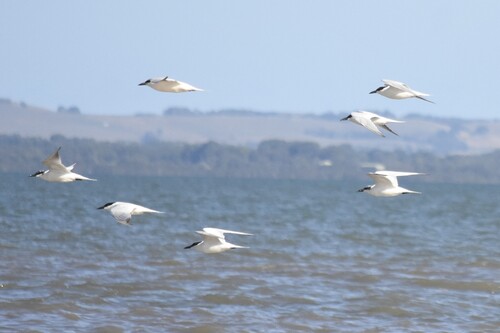
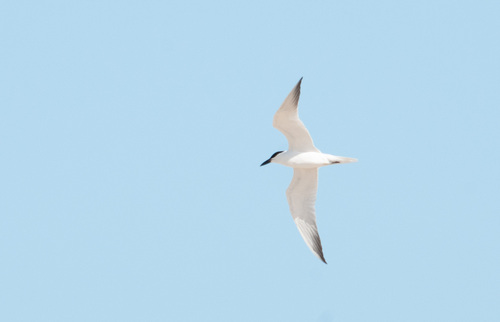
This is a fairly large and powerful tern, similar in size and general appearance to a Sandwich tern, but the short thick gull-like bill, broad wings, long legs and robust body are distinctive. The summer adult has pale grey upperparts, white underparts, a black cap, strong black bill and black legs. The call is a characteristic ker-wik. It is 33–42 cm (13–17 in) in length and 76–91 cm (30–36 in) in wingspan. Its weight ranges from 150–292 g (5.3–10.3 oz). It differs from the closely related gull-billed tern in being slightly larger, paler grey above, and with an obviously larger, heavier bill.
Text from Wikipedia, licensed CC BY-SA 4.0.
When to see the Australian Tern
One bar for each month. Filled bars are the 11 months with records; pale bars are months with none. The wide bar is October, the month with the most records.
Where to see the Australian Tern
The map shades 4 countries with regular records, and 2 more in a lighter tone where the bird turns up only as a stray. Everything unshaded has no records. Countries are listed below the map.
Recorded as a rare visitor in Thailand, Timor-Leste.
About the Australian Tern
The Australian tern or Australian gull-billed tern is a tern in the family Laridae, native to Australia. The genus name is from Ancient Greek gelao, "to laugh", and khelidon, "swallow".
Text adapted from Wikipedia, licensed CC BY-SA 4.0.
Easily confused with

Side by side: Australian Tern vs Gull-billed Tern
Learn the Australian Tern in the BeakBrain App
Photo and call practice. Coming soon to iPhone and Android.
Play today's Daily BirdEvery photo and recording on this page is credited to its author under the licence shown. Spotted a problem with this page, or have a better photo? Contribute.