Learn what every symbol on the card means.Full credits and sources at beakbrain.com/symbols
 ForestCavity nestMedium · 167 g


ID tip
The groove-billed toucanet is 33 to 37 cm (13 to 15 in) long and weighs 130 to 200 g (4.6 to 7.1 oz). Its grooved culmen and mandible give it its English name. In the nominate subspecies and A. s. erythrognathus, most of the bill is wine-red to brown-red with a diagonal black stripe on the mandible. The nominate's bill also has a vertical white stripe at its base. In A. s. calorhynchus the bill is mostly yellow with a reduced amount of black, some orange-red at the base of the mandible, and a white stripe like the nominate's. Voice: The groove-billed toucanet's song is "barking-growling notes or croaks...wik-wik- to waak-waak-", sometimes sung in duet. Male's voices are lower pitched than female's. A. s. erythrognathus' song sounds similar to those of the other subspecies but is apparently faster.
Text from Wikipedia, licensed CC BY-SA 4.0.
When to see the Groove-billed Toucanet
One bar for each month. Filled bars are the 11 months with records; pale bars are months with none. The wide bar is February, the month with the most records.
Where to see the Groove-billed Toucanet
The map shades 2 countries with regular records. Everything unshaded has no records. Countries are listed below the map.
About the Groove-billed Toucanet
The groove-billed toucanet is a near-passerine bird in the toucan family Ramphastidae. It is found in Colombia and Venezuela.
Text adapted from Wikipedia, licensed CC BY-SA 4.0.
Easily confused with
 Blue-banded ToucanetAulacorhynchus coeruleicinctisThe blue-banded toucanet is 40 to 44 cm (16 to 17 in) long and weighs 173 to 257 g (6.1 to 9.1 oz).
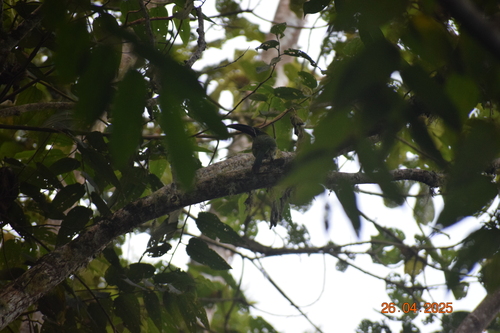 Chestnut-tipped ToucanetAulacorhynchus derbianusThe chestnut-tipped toucanet is 33 to 41 cm (13 to 16 in) long and weighs 141 to 262 g (5.0 to 9.2 oz).
 Tepui ToucanetAulacorhynchus whitelianusThe tepui toucanet is 33 to 41 cm (13 to 16 in) long and weighs 117 to 160 g (4.1 to 5.6 oz).
Side by side: Groove-billed Toucanet vs Northern Emerald Toucanet · Groove-billed Toucanet vs Southern Emerald Toucanet · Crimson-rumped Toucanet vs Groove-billed Toucanet · Blue-banded Toucanet vs Groove-billed Toucanet
Learn the Groove-billed Toucanet in the BeakBrain App
Photo and call practice. Coming soon to iPhone and Android.
Play today's Daily BirdEvery photo and recording on this page is credited to its author under the licence shown. Spotted a problem with this page, or have a better photo? Contribute.