Learn what every symbol on the card means.Full credits and sources at beakbrain.com/symbols
 ForestMedium · 210 g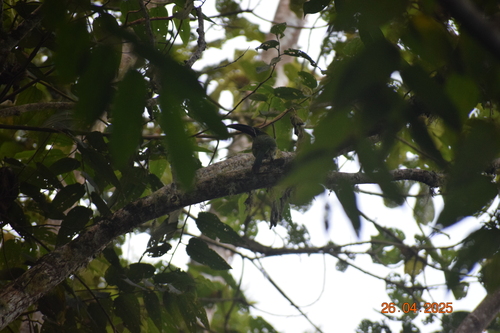


What the Chestnut-tipped Toucanet sounds like

ID tip
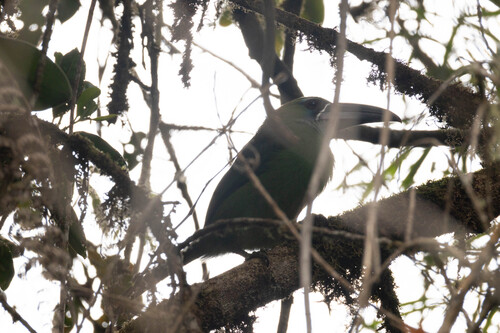
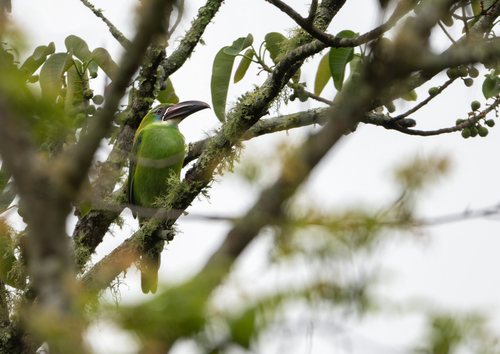
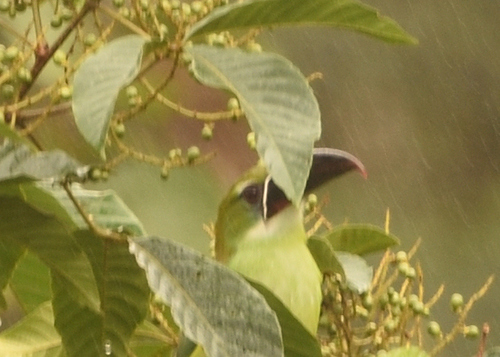
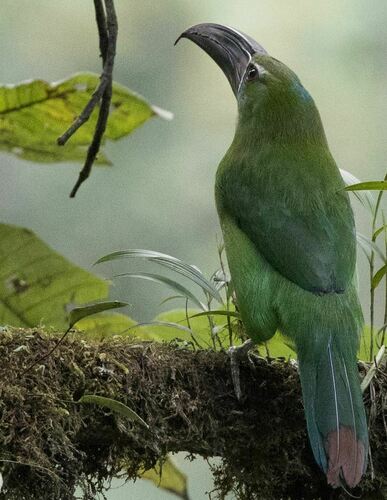
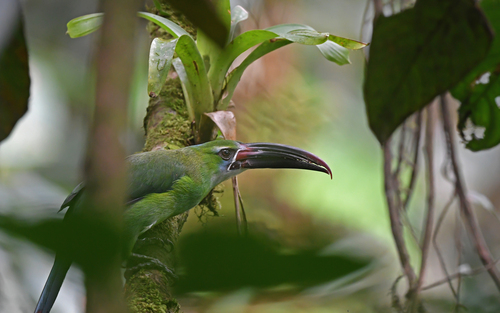
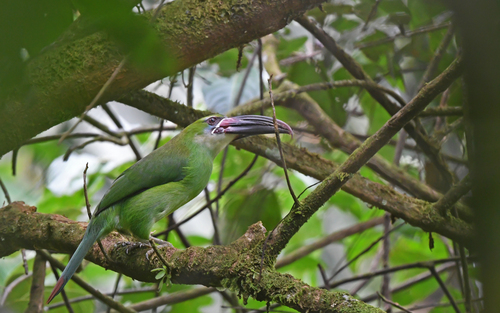
The chestnut-tipped toucanet is 33 to 41 cm (13 to 16 in) long and weighs 141 to 262 g (5.0 to 9.2 oz). Its bill is deep red and black with a vertical white line at its base and grooves on the maxilla. (Some individuals have an all-black bill). The sexes are alike. Their plumage is generally green, with a bluish nape, a white throat, and wide chestnut tips on the tail feathers. The red-brown eye has some blue below it. Voice: The chestnut-tipped toucanet's song is an "often long series of grrrrump to kwuk notes", which pairs often sing together. It also makes "'ggg-rgg', 'ngg-ngg', and rattling 'bbdt-bbdt' notes."
Text from Wikipedia, licensed CC BY-SA 4.0.
When to see the Chestnut-tipped Toucanet
One bar for each month. Filled bars are the 11 months with records; pale bars are months with none. The wide bar is October, the month with the most records.
Where to see the Chestnut-tipped Toucanet
The map shades 3 countries with regular records. Everything unshaded has no records. Countries are listed below the map.
About the Chestnut-tipped Toucanet
The chestnut-tipped toucanet is a near-passerine bird in the toucan family Ramphastidae. It is found in Bolivia, Colombia, Ecuador, and Peru.
Text adapted from Wikipedia, licensed CC BY-SA 4.0.
Easily confused with
 Blue-banded ToucanetAulacorhynchus coeruleicinctisThe blue-banded toucanet is 40 to 44 cm (16 to 17 in) long and weighs 173 to 257 g (6.1 to 9.1 oz).
 Tepui ToucanetAulacorhynchus whitelianusThe tepui toucanet is 33 to 41 cm (13 to 16 in) long and weighs 117 to 160 g (4.1 to 5.6 oz).
Yellow-browed ToucanetAulacorhynchus huallagaeThe yellow-browed toucanet is 38 to 44 cm (15 to 17 in) long and weighs about 250 to 280 g (8.8 to 9.9 oz).
Tepui ToucanetAulacorhynchus whitelianusThe tepui toucanet is 33 to 41 cm (13 to 16 in) long and weighs 117 to 160 g (4.1 to 5.6 oz).
Yellow-browed ToucanetAulacorhynchus huallagaeThe yellow-browed toucanet is 38 to 44 cm (15 to 17 in) long and weighs about 250 to 280 g (8.8 to 9.9 oz).
Learn the Chestnut-tipped Toucanet in the BeakBrain App
Photo and call practice. Coming soon to iPhone and Android.
Play today's Daily BirdEvery photo and recording on this page is credited to its author under the licence shown. Spotted a problem with this page, or have a better photo? Contribute.