Learn what every symbol on the card means.Full credits and sources at beakbrain.com/symbols
 WetlandPlatform nestLarge · 1.4 kg




What the Grey Heron sounds like


ID tip
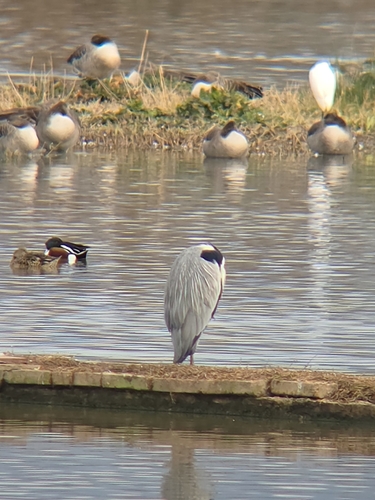
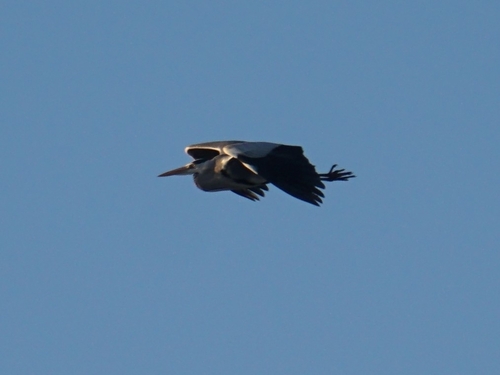
The grey heron is a large bird, standing up to 100 cm (40 in) tall and measuring 84–102 cm (33–40 in) long with a 155–195 cm (61–77 in) wingspan. The body weight can range from 1.02–2.08 kg (2 lb 4 oz – 4 lb 9+1⁄4 oz). The plumage is largely ashy-grey above, and greyish-white below, with some black on the flanks. Adults have a white head and neck with a broad black supercilium that terminates in the slender, dangling crest, and bluish-black streaks on the front of the neck. The scapular feathers and the feathers at the base of the neck are somewhat elongated.
Text from Wikipedia, licensed CC BY-SA 4.0.
When to see the Grey Heron
One bar for each month, and every month is filled: this bird is recorded here in all twelve. The wide bar is January, the month with the most records.
Where to see the Grey Heron
The map shades 162 countries with regular records, and 6 more in a lighter tone where the bird turns up only as a stray. Everything unshaded has no records. Countries are listed below the map.
Recorded as a rare visitor in Canada, United States, Australia, Brazil, Martinique, Réunion.
About the Grey Heron
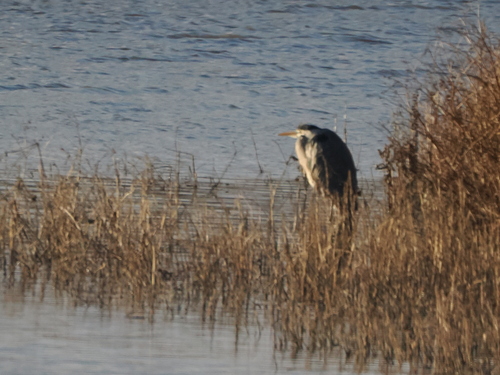
The grey heron is a long-legged wading bird of the heron family, Ardeidae, native throughout temperate Europe and Asia, and also parts of Africa. It is resident in much of its range, but some populations from the more northern parts migrate southwards in autumn. A bird of wetland areas, it can be seen around lakes, rivers, ponds, marshes and on the sea coast. It feeds mostly on aquatic creatures which it catches after standing stationary beside or in the water, or stalking its prey through the shallows.
Text adapted from Wikipedia, licensed CC BY-SA 4.0.
Easily confused with
 Western Cattle EgretArdea ibisThe cattle egret is a stocky heron with an 88–96 cm (35–38 in) wingspan; it is 46–56 cm (18–22 in) long and weighs 270–512 g (9.5–18.1 oz).
 Purple HeronArdea purpureaThe purple heron is a large bird, 78–97 cm (31–38 in) in length with a standing height from 70 to 94 cm (28 to 37 in) and a 120–152 cm (47–60 in) wingspan.
 Black-headed HeronArdea melanocephalaThe black-headed heron is a wading bird of the heron family Ardeidae, common throughout much of sub-Saharan Africa and Madagascar.
Side by side: Great Blue Heron vs Grey Heron · Great Egret vs Grey Heron · Grey Heron vs Western Cattle Egret · Grey Heron vs Purple Heron
Learn the Grey Heron in the BeakBrain App
Photo and call practice. Coming soon to iPhone and Android.
Play today's Daily BirdEvery photo and recording on this page is credited to its author under the licence shown. Spotted a problem with this page, or have a better photo? Contribute.