Learn what every symbol on the card means.Full credits and sources at beakbrain.com/symbols
 WetlandCavity nestMedium · 71 g



What the Green Sandpiper sounds like


ID tip
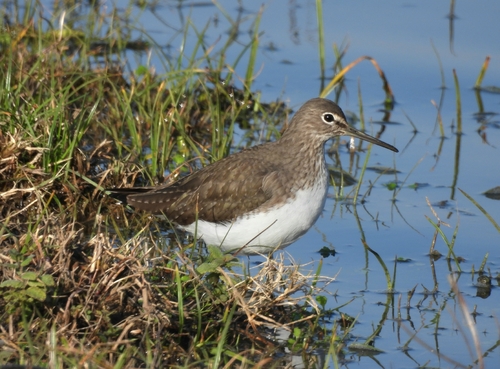
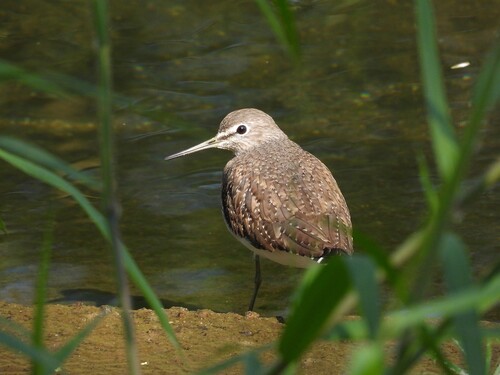
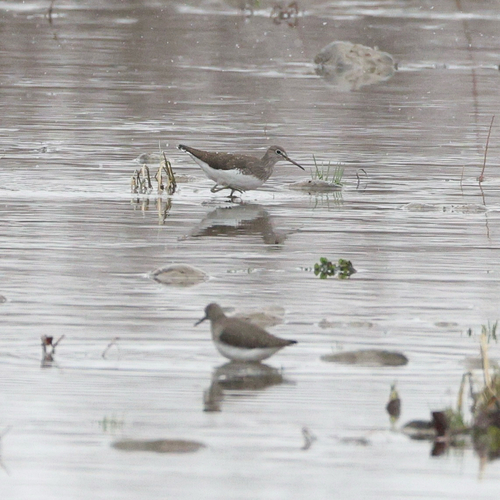
This species is a somewhat plump wader with a dark greenish-brown back and wings, greyish head and breast and otherwise white underparts. The back is spotted white to varying extents, being maximal in the breeding adult, and less in winter and young birds. The legs and short bill are both dark green. It is conspicuous and characteristically patterned in flight, with the wings dark above and below and a brilliant white rump. The latter feature reliably distinguishes it from the slightly smaller but otherwise very similar solitary sandpiper (T. solitaria) of North America.
Text from Wikipedia, licensed CC BY-SA 4.0.
When to see the Green Sandpiper
One bar for each month, and every month is filled: this bird is recorded here in all twelve. The wide bar is April, the month with the most records.
Where to see the Green Sandpiper
The map shades 140 countries with regular records, and 7 more in a lighter tone where the bird turns up only as a stray. Everything unshaded has no records. Countries are listed below the map.
Recorded as a rare visitor in United States, Australia, Somalia, Guadeloupe, Andorra, Liechtenstein, Northern Mariana Islands.
About the Green Sandpiper
The green sandpiper is a small wader (shorebird) of the Old World.
Text adapted from Wikipedia, licensed CC BY-SA 4.0.
Easily confused with
 Wood SandpiperTringa glareolaThe wood sandpiper resembles a longer-legged, more delicate form of the aforementioned green sandpiper (T. ochropus), or a solitary sandpiper (T. solitaria), albeit with a shorter, finer bill, brown back and longer yellowish legs.
 Solitary SandpiperTringa solitariaThis species measures 18–23 cm (7.1–9.1 in) long, with a wingspan up to 50 cm (20 in) and a body mass of 31–65 g (1.1–2.3 oz).
 Common GreenshankTringa nebulariaCommon greenshanks are brown in breeding plumage, and grey-brown in winter.
Side by side: Green Sandpiper vs Wood Sandpiper · Common Greenshank vs Green Sandpiper · Green Sandpiper vs Solitary Sandpiper
Learn the Green Sandpiper in the BeakBrain App
Photo and call practice. Coming soon to iPhone and Android.
Play today's Daily BirdEvery photo and recording on this page is credited to its author under the licence shown. Spotted a problem with this page, or have a better photo? Contribute.