Learn what every symbol on the card means.Full credits and sources at beakbrain.com/symbols
 RiverineScrapeLarge · 790 g





ID tip
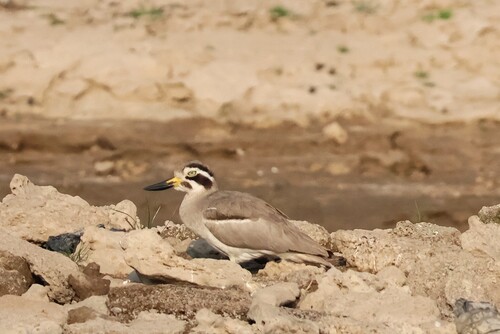
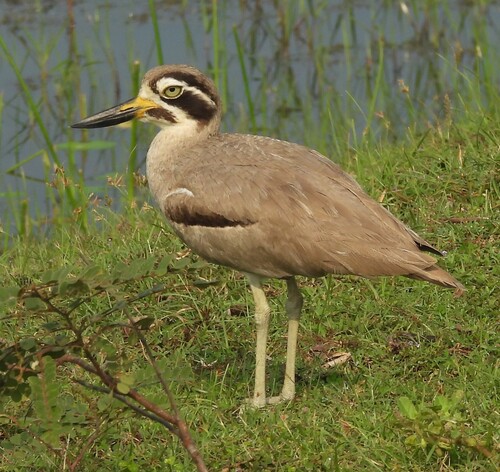
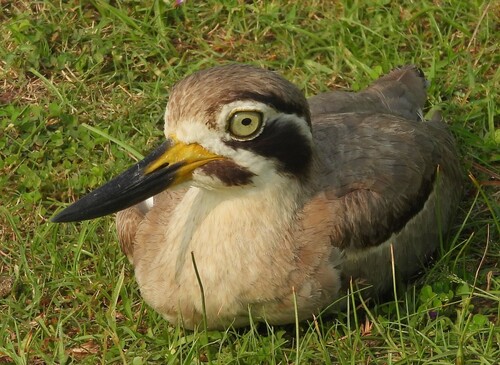
The great thick-knee is a large wader at 49–55 cm, and has a massive 7 cm bill with the lower mandible with a sharp angle giving it an upturned appearance. It has unstreaked grey-brown upperparts and breast, with rest of the underparts whitish. The face has a striking black and white pattern, and the bill is black with a yellow base. The eyes are bright yellow and the legs a duller greenish-yellow. In flight, the great thick-knee shows black and white flight feathers on the upperwing, and a mainly white underwing. Sexes are similar, but young birds are slightly paler than adults.
Text from Wikipedia, licensed CC BY-SA 4.0.
When to see the Great Stone-curlew
One bar for each month. Filled bars are the 7 months with records; pale bars are months with none. The wide bar is February, the month with the most records.
Where to see the Great Stone-curlew
The map shades 14 countries with regular records, and 1 more in a lighter tone where the bird turns up only as a stray. Everything unshaded has no records. Countries are listed below the map.
Recorded as a rare visitor in Hong Kong SAR China.
About the Great Stone-curlew
The great stone-curlew or great thick-knee is a large wader which is a resident breeder in tropical southern Asia from India, Pakistan, Sri Lanka, Bangladesh into South-east Asia.
Text adapted from Wikipedia, licensed CC BY-SA 4.0.
Easily confused with

Side by side: Beach Stone-curlew vs Great Stone-curlew
Learn the Great Stone-curlew in the BeakBrain App
Photo and call practice. Coming soon to iPhone and Android.
Play today's Daily BirdEvery photo and recording on this page is credited to its author under the licence shown. Spotted a problem with this page, or have a better photo? Contribute.