Learn what every symbol on the card means.Full credits and sources at beakbrain.com/symbols
 CoastalScrapeLarge · 1.0 kg

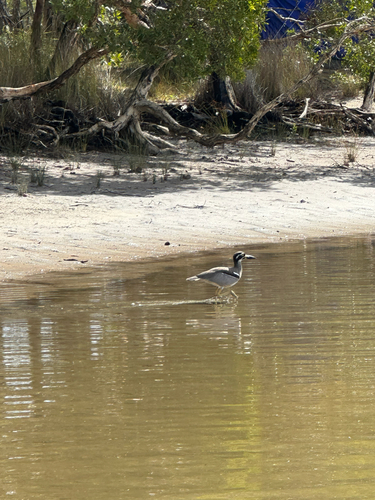


ID tip
The beach stone-curlew is 54-56 cm (21-22 in) long. At a mean of 1,032 g (2.275 lb) in males and 1,000 g (2.2 lb) in females, it is the heaviest living member of the Charadriiformes outside of the gull and skua families. They have black and white face patterning, yellow eyes and a grey-brown upper body. Voice: As an alarm, the bird will make a chwip-chwip to ward creatures away from their territory.
Text from Wikipedia, licensed CC BY-SA 4.0.
When to see the Beach Stone-curlew
One bar for each month, and every month is filled: this bird is recorded here in all twelve. The wide bar is October, the month with the most records.
Where to see the Beach Stone-curlew
The map shades 11 countries with regular records. Everything unshaded has no records. Countries are listed below the map.
About the Beach Stone-curlew
The beach stone-curlew also known as beach thick-knee is a large, ground-dwelling bird that occurs in Australasia, the islands of South-east Asia. At 55 cm (22 in) and 1 kg (2.2 lb), it is one of the world's largest shorebirds.
Text adapted from Wikipedia, licensed CC BY-SA 4.0.
Easily confused with

Side by side: Beach Stone-curlew vs Great Stone-curlew
Learn the Beach Stone-curlew in the BeakBrain App
Photo and call practice. Coming soon to iPhone and Android.
Play today's Daily BirdEvery photo and recording on this page is credited to its author under the licence shown. Spotted a problem with this page, or have a better photo? Contribute.