Learn what every symbol on the card means.Full credits and sources at beakbrain.com/symbols
 ForestPlatform nestHuge · 4.1 kg



ID tip
At 78–100 cm (31–39 in) in length and 3.1–4.8 kg (6.8–10.6 lb) in weight, this is a very large cracid. Females are somewhat smaller than males. It is the most massive and heavy species in the family but its length is matched by a few other cracids. Three other species of curassow (the northern helmeted, the southern helmeted, and the black are all around the same average length as the great curassow. In this species, standard measurements are as follows: the wing chord is 36 to 42.4 cm (14.2 to 16.7 in), the tail is 29 to 38 cm (11 to 15 in) and the tarsus is 9.4 to 12 cm (3.7 to 4.7 in).
Text from Wikipedia, licensed CC BY-SA 4.0.
When to see the Great Curassow
One bar for each month. Filled bars are the 11 months with records; pale bars are months with none. The wide bar is March, the month with the most records.
Where to see the Great Curassow
The map shades 9 countries with regular records, and 1 more in a lighter tone where the bird turns up only as a stray. Everything unshaded has no records. Countries are listed below the map.
Recorded as a rare visitor in Ecuador.
About the Great Curassow
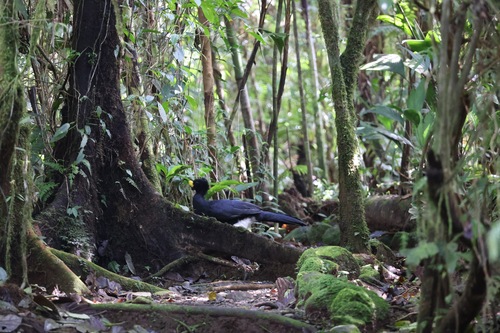
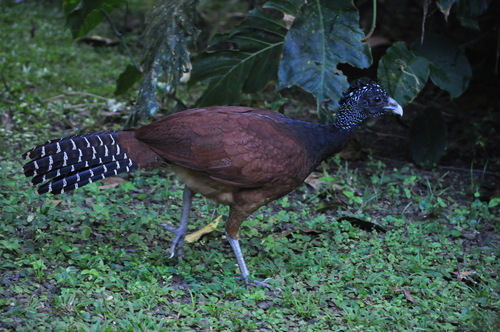
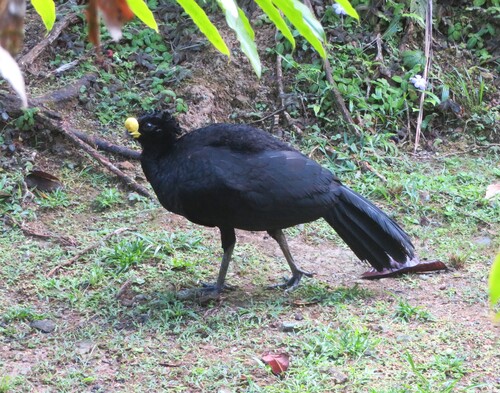
The great curassow is a large, pheasant-like bird from the Neotropical rainforests, its range extending from eastern Mexico, through Central America to western Colombia and northwestern Ecuador. Male birds are black with curly crests and yellow beaks; females come in three colour morphs, barred, rufous and black. These birds form small groups, foraging mainly on the ground for fruits and arthropods, and the occasional small vertebrate, but they roost and nest in trees. This species is monogamous, the male usually building the rather small nest of leaves in which two eggs are laid.
Text adapted from Wikipedia, licensed CC BY-SA 4.0.
Easily confused with
 Bare-faced CurassowCrax fasciolataThe bare-faced curassow is a large bird reaching a length of 82 to 92 centimetres (32 to 36 in).
 Black CurassowCrax alectorThe black curassow is a large bird reaching about 900 millimetres (35 in) in length.
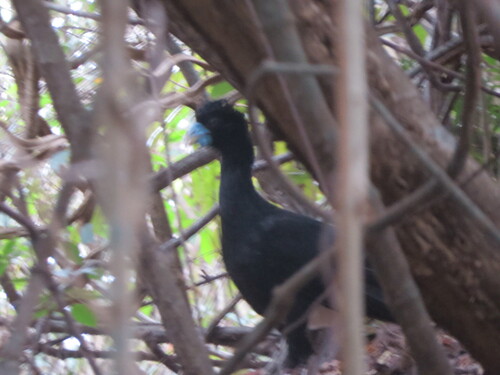 Blue-billed CurassowCrax albertiThe blue-billed curassow is 82.5 to 92.5 cm (2.7 to 3.0 ft) long and weighs 3.2 to 3.6 kg (7.1 to 7.9 lb).
Side by side: Bare-faced Curassow vs Great Curassow · Black Curassow vs Great Curassow
Learn the Great Curassow in the BeakBrain App
Photo and call practice. Coming soon to iPhone and Android.
Play today's Daily BirdEvery photo and recording on this page is credited to its author under the licence shown. Spotted a problem with this page, or have a better photo? Contribute.