Learn what every symbol on the card means.Full credits and sources at beakbrain.com/symbols
 ForestPlatform nestHuge · 2.9 kg


ID tip
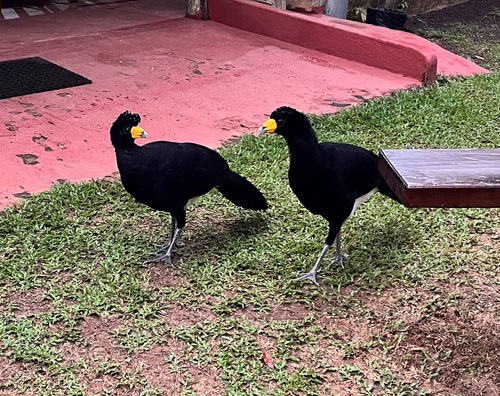
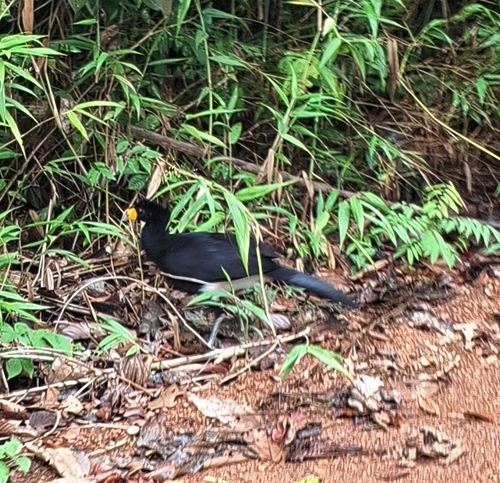
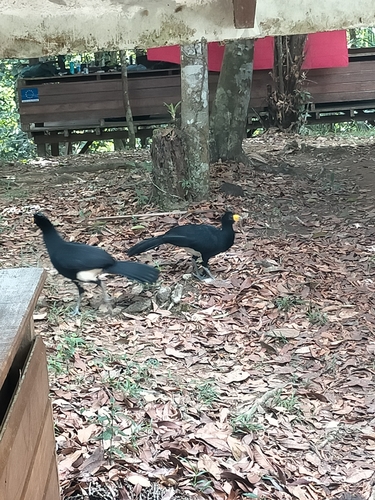
The black curassow is a large bird reaching about 900 millimetres (35 in) in length. The male has black upper parts glossed with a purplish sheen and an inconspicuous black crest. The skin at the base of the grey beak is yellow or orange but there are no knobs and wattles. The underparts are white. The female is similar but the crest is barred with white, and the juvenile is black, barred and mottled with reddish-brown and reddish-buff.
Text from Wikipedia, licensed CC BY-SA 4.0.
When to see the Black Curassow
One bar for each month. Filled bars are the 11 months with records; pale bars are months with none. The wide bar is February, the month with the most records.
Where to see the Black Curassow
The map shades 6 countries with regular records. Everything unshaded has no records. Countries are listed below the map.
About the Black Curassow
The black curassow, also known as the smooth-billed curassow and the crested curassow, is a species of bird in the family Cracidae, the chachalacas, guans, and curassows. It is found in humid forests in northern South America in Colombia, Venezuela, the Guianas including Suriname, and far northern Brazil, and is introduced to Bahamas, Cuba, Jamaica, Haiti, Dominican Republic, Puerto Rico and Lesser Antilles. It is the only Crax curassow where the male and female cannot be separated by plumage, as both are essentially black with a white crissum, and have a yellow or orange-red cere.
Text adapted from Wikipedia, licensed CC BY-SA 4.0.
Easily confused with
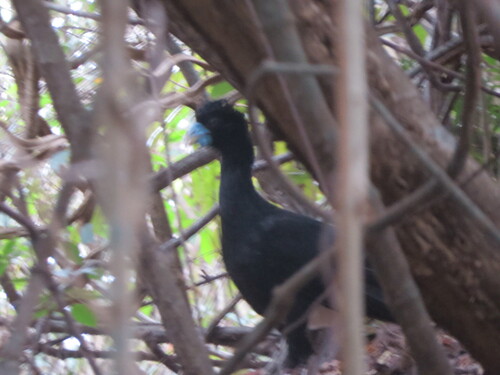 Blue-billed CurassowCrax albertiThe blue-billed curassow is 82.5 to 92.5 cm (2.7 to 3.0 ft) long and weighs 3.2 to 3.6 kg (7.1 to 7.9 lb).
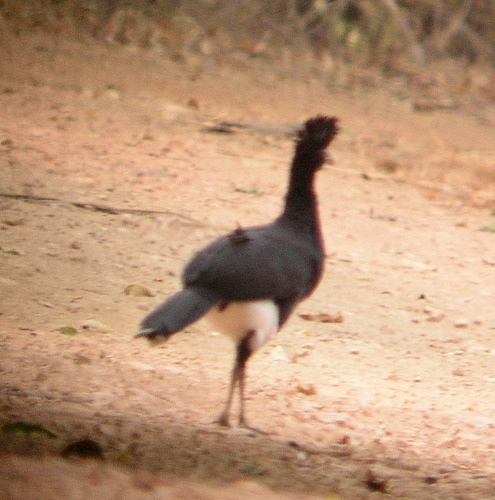 Yellow-knobbed CurassowCrax daubentoniThe yellow-knobbed curassow is 84 to 92.5 cm (2.8 to 3.0 ft) long.
 Red-billed CurassowCrax blumenbachiiThe red-billed curassow is a large bird reaching a length of 82 to 92 centimetres (32 to 36 in).
Side by side: Black Curassow vs Great Curassow · Bare-faced Curassow vs Black Curassow
Learn the Black Curassow in the BeakBrain App
Photo and call practice. Coming soon to iPhone and Android.
Play today's Daily BirdEvery photo and recording on this page is credited to its author under the licence shown. Spotted a problem with this page, or have a better photo? Contribute.