Learn what every symbol on the card means.Full credits and sources at beakbrain.com/symbols
 ForestPlatform nestHuge · 2.8 kg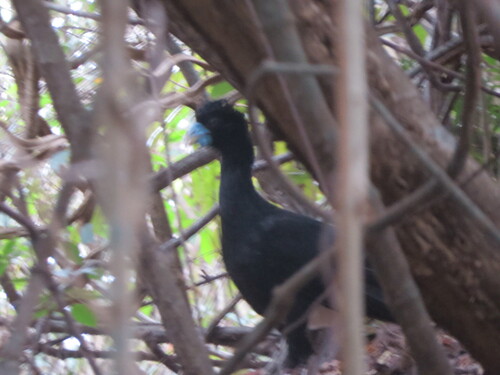


ID tip
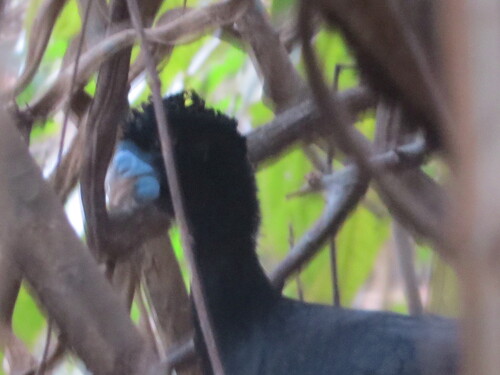
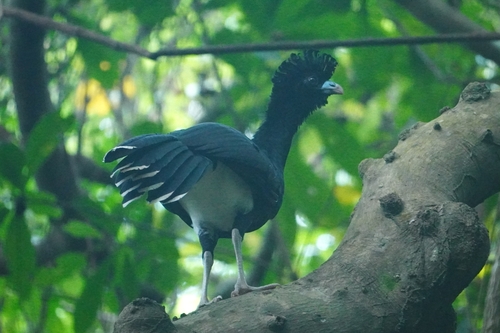
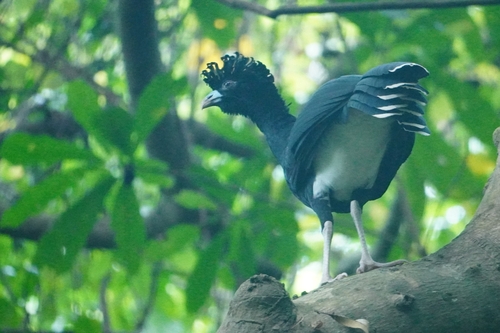
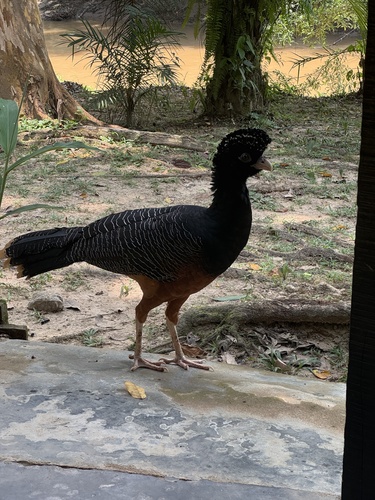
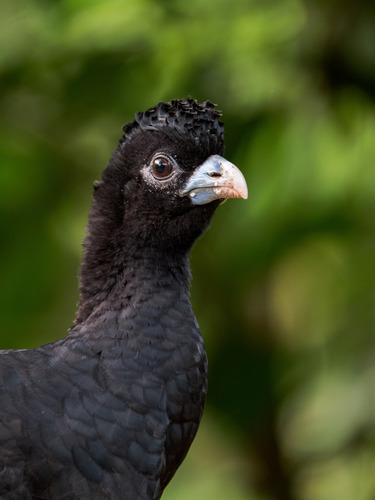
The blue-billed curassow is 82.5 to 92.5 cm (2.7 to 3.0 ft) long and weighs 3.2 to 3.6 kg (7.1 to 7.9 lb). It is the only curassow with a blue cere and wattle, the latter found only on the male. Males are mostly black with a white vent and tail tip. Females are also mostly black but their lower belly and vent are rufous. They have fine white barring on the wings and tail, and a rare "barred" morph also has barring on the breast and belly. Both sexes have an erectile crest, the male's black and the female's black and white. Voice: Male blue-billed curassows "boom" from the ground, "a 4–5-syllable series of deep notes...repeated over and over, 'hmm...hmh...hmm...hmm...hmh'". Both sexes give an alarm call, a "soft, high-pitched whistle 'peh-weeeéoh' or 'pehoo'".
Text from Wikipedia, licensed CC BY-SA 4.0.
When to see the Blue-billed Curassow
One bar for each month. Filled bars are the 11 months with records; pale bars are months with none. The wide bar is January, the month with the most records.
Where to see the Blue-billed Curassow
The map shades 1 country with regular records. Everything unshaded has no records. Countries are listed below the map.
About the Blue-billed Curassow
The blue-billed curassow is a species of bird in the family Cracidae, the chachalacas, guans, and curassows. It is endemic to Colombia.
Text adapted from Wikipedia, licensed CC BY-SA 4.0.
Easily confused with
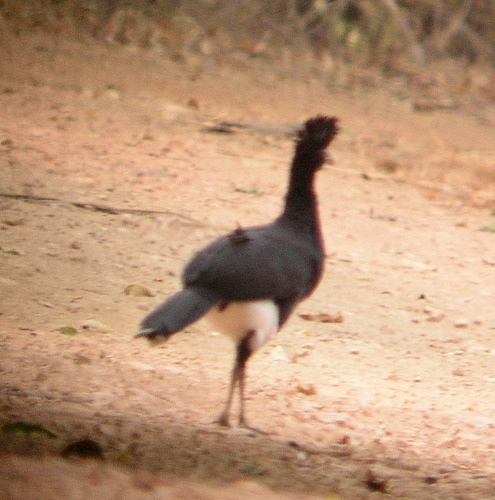 Yellow-knobbed CurassowCrax daubentoniThe yellow-knobbed curassow is 84 to 92.5 cm (2.8 to 3.0 ft) long.
 Red-billed CurassowCrax blumenbachiiThe red-billed curassow is a large bird reaching a length of 82 to 92 centimetres (32 to 36 in).
 Wattled CurassowCrax globulosaThe wattled curassow is about 82–89 cm (32–35 in) long, and weighs around 2,500 g (88 oz).
Learn the Blue-billed Curassow in the BeakBrain App
Photo and call practice. Coming soon to iPhone and Android.
Play today's Daily BirdEvery photo and recording on this page is credited to its author under the licence shown. Spotted a problem with this page, or have a better photo? Contribute.