Learn what every symbol on the card means.Full credits and sources at beakbrain.com/symbols
 ForestPlatform nestHuge · 2.5 kg


ID tip
The wattled curassow is about 82–89 cm (32–35 in) long, and weighs around 2,500 g (88 oz). It is a large curassow lacking the white tail-tips found in many of these birds; the feathers along the crest of its head are curled forwards. Males have black plumage all over except for the white crissum. The irides are dark brown; legs, feet and bill are blackish. It has conspicuous crimson bill ornaments—a round red knob with bony core adorns the maxilla base, while the cere extends apically at least halfway under this knob and below the mandible base forms a small fleshy wattle.
Text from Wikipedia, licensed CC BY-SA 4.0.
When to see the Wattled Curassow
One bar for each month. Filled bars are the 11 months with records; pale bars are months with none. The wide bar is May, the month with the most records.
Where to see the Wattled Curassow
The map shades 4 countries with regular records. Everything unshaded has no records. Countries are listed below the map.
About the Wattled Curassow
The wattled curassow is a threatened member of the family Cracidae, the curassows, guans, and chachalacas. It is found in remote rainforests in the western Amazon basin in South America. Males have black plumage, except for a white crissum, with curly feathers on the head and red bill ornaments and wattles. Females and juveniles are similar but lack the bill ornamentation and have a reddish-buff crissum area. The wattled curassow is sister to other southern Crax curassows. In captivity, it sometimes hybridises with the blue-billed curassow.
Text adapted from Wikipedia, licensed CC BY-SA 4.0.
Easily confused with
 Red-billed CurassowCrax blumenbachiiThe red-billed curassow is a large bird reaching a length of 82 to 92 centimetres (32 to 36 in).
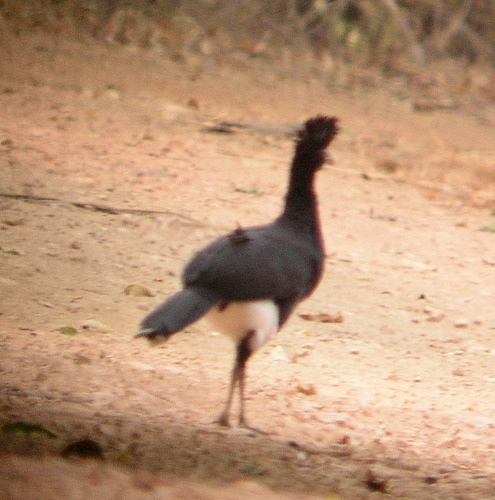 Yellow-knobbed CurassowCrax daubentoniThe yellow-knobbed curassow is 84 to 92.5 cm (2.8 to 3.0 ft) long.
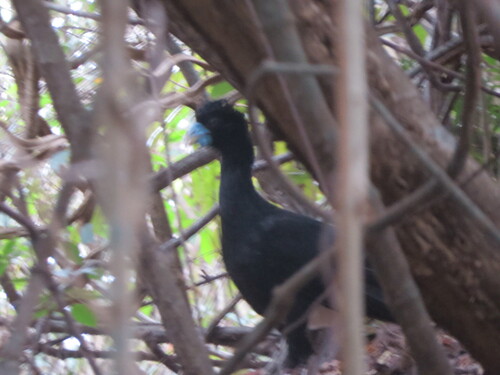 Blue-billed CurassowCrax albertiThe blue-billed curassow is 82.5 to 92.5 cm (2.7 to 3.0 ft) long and weighs 3.2 to 3.6 kg (7.1 to 7.9 lb).
Learn the Wattled Curassow in the BeakBrain App
Photo and call practice. Coming soon to iPhone and Android.
Play today's Daily BirdEvery photo and recording on this page is credited to its author under the licence shown. Spotted a problem with this page, or have a better photo? Contribute.