Learn what every symbol on the card means.Full credits and sources at beakbrain.com/symbols
 Coastal280 g




ID tip
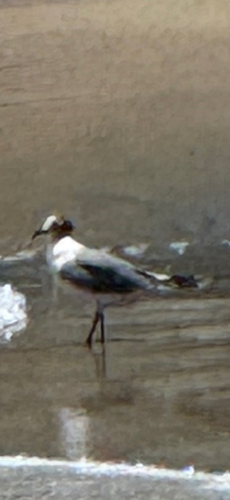
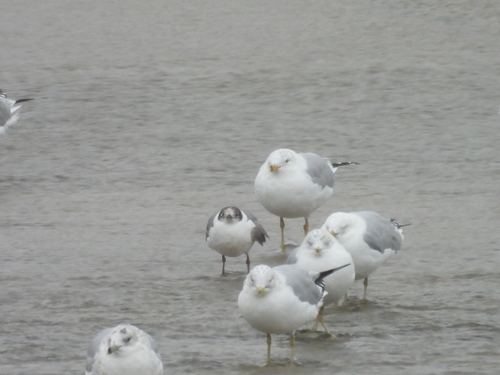
It breeds in central provinces of Canada and adjacent states of the northern United States. It is a migratory bird, wintering in Argentina, the Caribbean, Chile, and Peru. The summer adult's body is white and its back and wings are much darker grey than all other gulls of similar size except the larger laughing gull. The wings have black tips with an adjacent white band. The bill and legs are red. The black hood of the breeding adult is mostly lost in winter. Young birds are similar to the adult but have less developed hoods and lack the white wing band.
Text from Wikipedia, licensed CC BY-SA 4.0.
When to see the Franklin's Gull
One bar for each month. Filled bars are the 8 months with records; pale bars are months with none. The wide bar is May, the month with the most records.
Where to see the Franklin's Gull
The map shades 42 countries with regular records, and 18 more in a lighter tone where the bird turns up only as a stray. Everything unshaded has no records. Countries are listed below the map.
Recorded as a rare visitor in Belgium, Sweden, France, Brazil, Germany, Morocco, New Zealand, Ireland, Finland, Netherlands, Israel, Barbados, Bolivia, Paraguay, China, Mauritania, Seychelles, St. Barthélemy.
About the Franklin's Gull
Franklin's gull is a small gull. The genus name Leucophaeus is from Ancient Greek leukos, "white", and phaios, "dusky". The specific pipixcan is a Nahuatl name for a type of gull. The English common name was given to commemorate the arctic explorer Sir John Franklin, who led an expedition in 1825 on which the type was collected.
Text adapted from Wikipedia, licensed CC BY-SA 4.0.
Easily confused with
 Grey GullLeucophaeus modestusThe sexes are similar in grey gulls.
 Dolphin GullLeucophaeus scoresbiiThe dolphin gull, sometimes erroneously called the red-billed gull, is a gull native to southern Chile and Argentina, and the Falkland Islands.
 Lava GullLeucophaeus fuliginosusThe lava gull is a distinctive gull, 51 to 55 cm (20–22 in) and weighs 380 g (13 oz).
Side by side: Franklin's Gull vs Laughing Gull · Franklin's Gull vs Grey Gull · Franklin's Gull vs Lava Gull
Learn the Franklin's Gull in the BeakBrain App
Photo and call practice. Coming soon to iPhone and Android.
Play today's Daily BirdEvery photo and recording on this page is credited to its author under the licence shown. Spotted a problem with this page, or have a better photo? Contribute.