Learn what every symbol on the card means.Full credits and sources at beakbrain.com/symbols
 DesertMedium · 380 g




ID tip
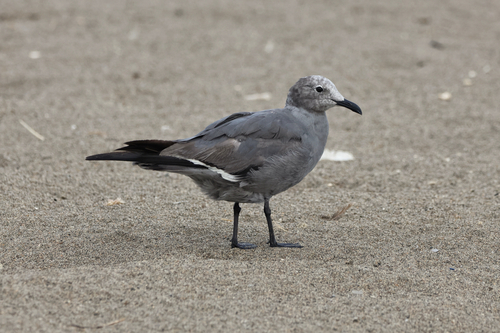
The sexes are similar in grey gulls. Adults grow to a length of about 45 cm (18 in) and weigh some 360 to 400 g (13 to 14 oz). The head is white in summer but brownish-grey in winter. The body and wings are grey with the dorsal surface rather darker than the ventral region. The flight feathers are black and the inner primaries and the secondaries have white tips, visible in flight. The tail has a band of black with a white trailing edge. The legs and beak are black and the iris is brown. The call is similar to that of the laughing gull (Leucophaeus atricilla).
Text from Wikipedia, licensed CC BY-SA 4.0.
When to see the Grey Gull
One bar for each month, and every month is filled: this bird is recorded here in all twelve. The wide bar is July, the month with the most records.
Where to see the Grey Gull
The map shades 5 countries with regular records, and 5 more in a lighter tone where the bird turns up only as a stray. Everything unshaded has no records. Countries are listed below the map.
Recorded as a rare visitor in United States, Mexico, Colombia, Brazil, Germany.
About the Grey Gull
The grey gull, also known as garuma gull, is a medium-sized gull native to South America. Unusual among gulls, it breeds inland in the extremely dry Atacama Desert in northern Chile, although it is present as a non-breeding bird along much of the Pacific coast of South America.
Text adapted from Wikipedia, licensed CC BY-SA 4.0.
Easily confused with
 Dolphin GullLeucophaeus scoresbiiThe dolphin gull, sometimes erroneously called the red-billed gull, is a gull native to southern Chile and Argentina, and the Falkland Islands.
 Lava GullLeucophaeus fuliginosusThe lava gull is a distinctive gull, 51 to 55 cm (20–22 in) and weighs 380 g (13 oz).
 Franklin's GullLeucophaeus pipixcanIt breeds in central provinces of Canada and adjacent states of the northern United States.
Side by side: Grey Gull vs Laughing Gull · Franklin's Gull vs Grey Gull · Grey Gull vs Lava Gull
Learn the Grey Gull in the BeakBrain App
Photo and call practice. Coming soon to iPhone and Android.
Play today's Daily BirdEvery photo and recording on this page is credited to its author under the licence shown. Spotted a problem with this page, or have a better photo? Contribute.