Learn what every symbol on the card means.Full credits and sources at beakbrain.com/symbols
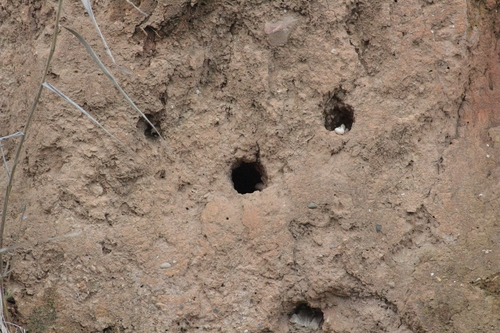
 WoodlandCavity nestSmall · 57 g

What the European Bee-eater sounds like


ID tip
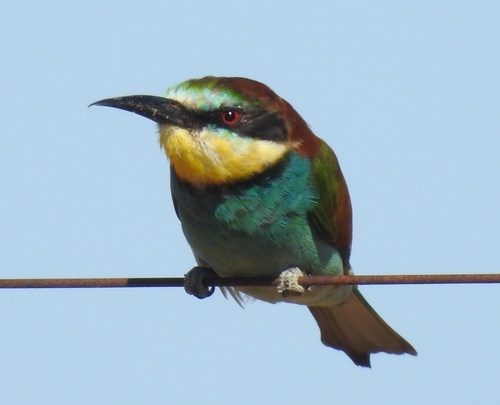
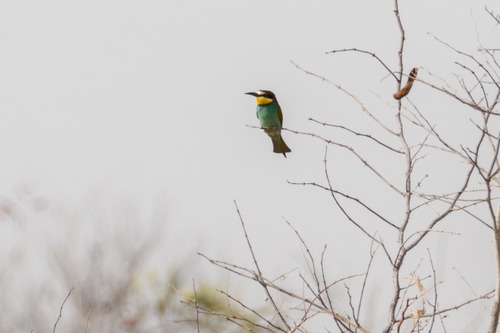
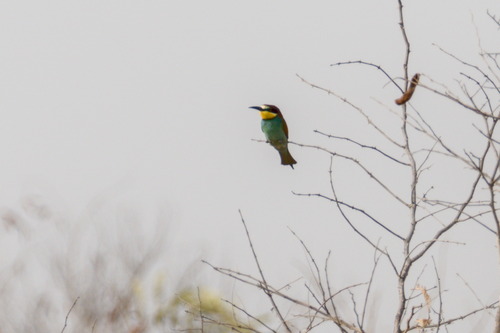
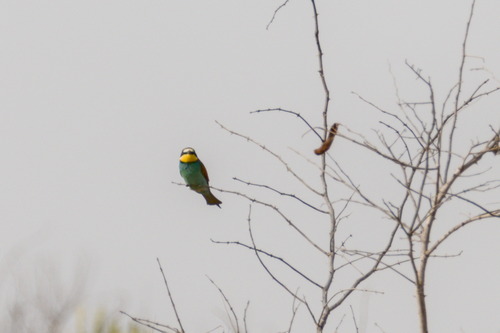
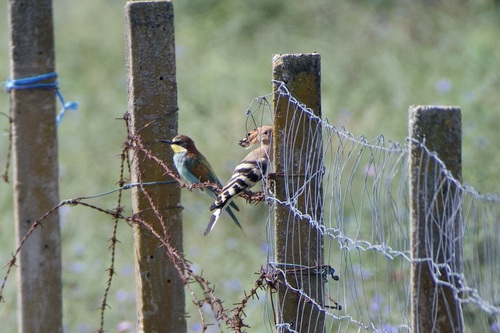
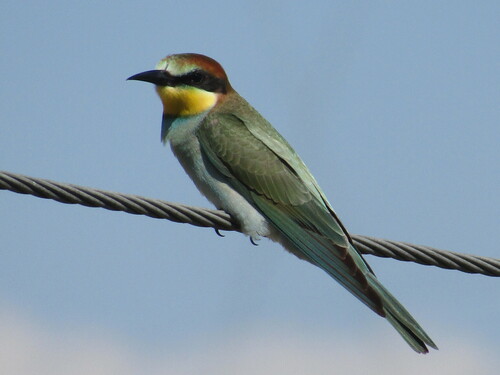
This species, like other bee-eaters, is a richly coloured, slender bird. It has brown and yellow upper parts, whilst the wings are green and the beak is black. It can reach a length of 27–29 cm (10.6–11.4 in), including the two elongated central tail feathers, and weigh 44–78 g (52 g on average). Sexes are alike. Female tends to have greener rather than gold feathers on shoulders. Non-breeding plumage is much duller and with a blue-green back and no elongated central tail feathers. Juvenile resembles a non-breeding adult, but with less variation in the feather colours.
Text from Wikipedia, licensed CC BY-SA 4.0.
When to see the European Bee-eater
One bar for each month. Filled bars are the 8 months with records; pale bars are months with none. The wide bar is May, the month with the most records.
Where to see the European Bee-eater
The map shades 112 countries with regular records, and 6 more in a lighter tone where the bird turns up only as a stray. Everything unshaded has no records. Countries are listed below the map.
Recorded as a rare visitor in Finland, Luxembourg, Ireland, Iceland, Chad, Guernsey.
About the European Bee-eater
The European bee-eater is a bird species in the bee-eater family, Meropidae. It breeds in southern and central Europe, northern and southern Africa, and western Asia. Except for the resident southern African population, the species is strongly migratory, wintering in tropical Africa. This species occurs as a spring overshoot north of its usual range, with occasional breeding in northern Europe.
Text adapted from Wikipedia, licensed CC BY-SA 4.0.
Easily confused with
 Asian Green Bee-eaterMerops orientalisLike other bee-eaters, this species is a slender, richly coloured bird.
 Blue-tailed Bee-eaterMerops philippinusThis species, like other bee-eaters, is a richly coloured, slender bird.
 Rainbow Bee-eaterMerops ornatusRainbow bee-eaters are brilliantly coloured birds that grow to be 23–28 cm (9.1–11.0 in) in length, including the elongated tail feathers, and weighing 20–33 g (0.71–1.16 oz).
Side by side: Asian Green Bee-eater vs European Bee-eater · Blue-tailed Bee-eater vs European Bee-eater · European Bee-eater vs Rainbow Bee-eater
Learn the European Bee-eater in the BeakBrain App
Photo and call practice. Coming soon to iPhone and Android.
Play today's Daily BirdEvery photo and recording on this page is credited to its author under the licence shown. Spotted a problem with this page, or have a better photo? Contribute.