Learn what every symbol on the card means.Full credits and sources at beakbrain.com/symbols
 WetlandCavity nestSmall · 34 g
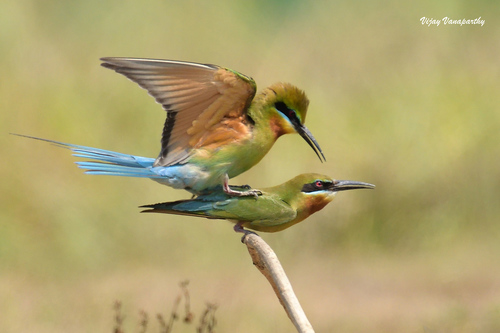
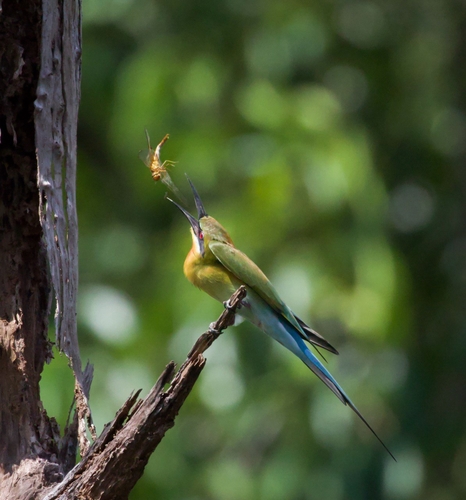
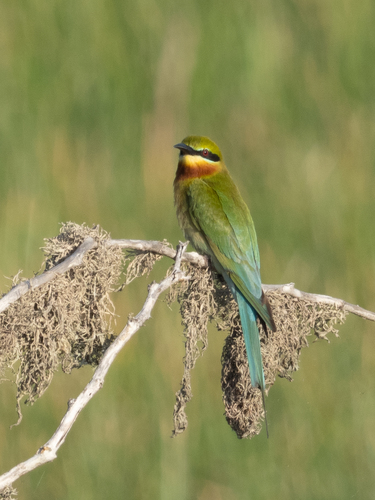
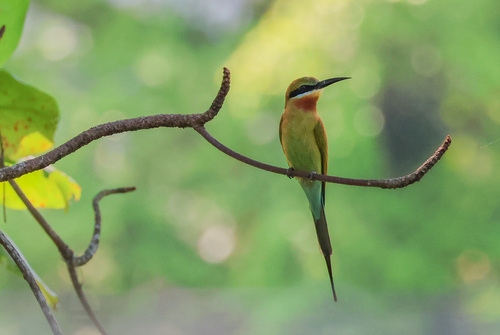
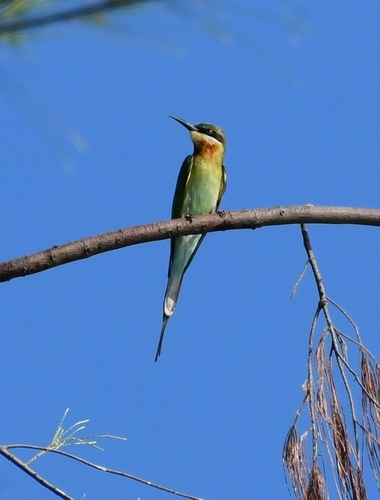
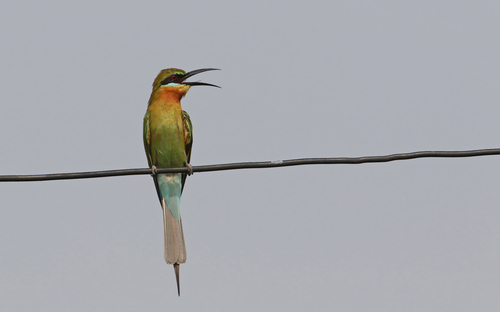
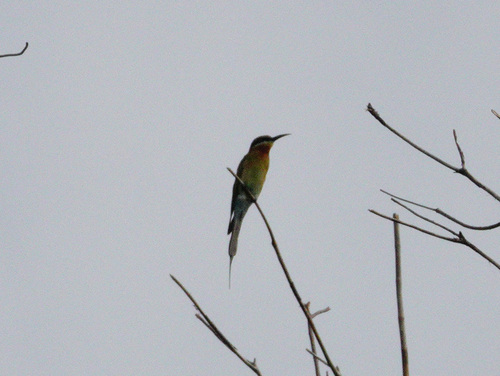
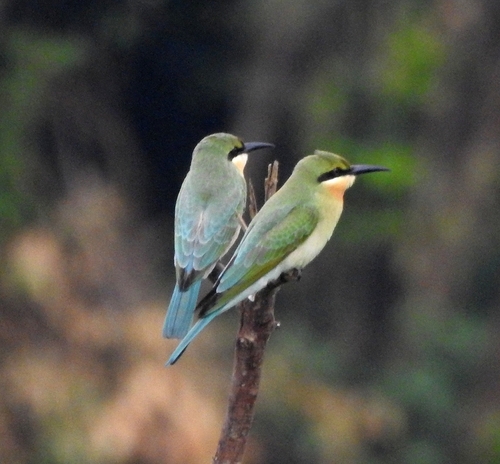
What the Blue-tailed Bee-eater sounds like

ID tip
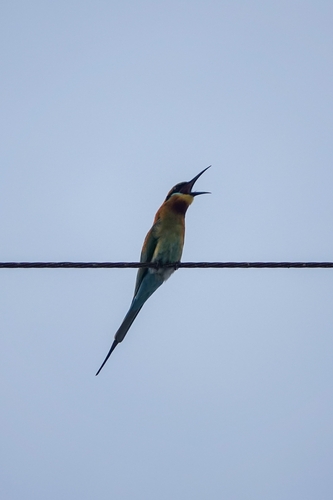
This species, like other bee-eaters, is a richly coloured, slender bird. It is predominantly green; its face has a narrow blue patch with a black eye stripe, and a yellow and brown throat; the tail is blue and the beak is black. The three outer toes are united around their bases. It is around 29 cm long excluding the elongated central tail feathers, which are an additional 7 cm long, and a weight of around 29–43 grams. Sexes are alike. The juveniles are drabber, and lack the elongated central tail feathers.
Text from Wikipedia, licensed CC BY-SA 4.0.
When to see the Blue-tailed Bee-eater
One bar for each month. Filled bars are the 8 months with records; pale bars are months with none. The wide bar is January, the month with the most records.
Where to see the Blue-tailed Bee-eater
The map shades 21 countries with regular records. Everything unshaded has no records. Countries are listed below the map.
About the Blue-tailed Bee-eater
The blue-tailed bee-eater is a bee-eater species mostly seen in open habitats close to water. It is widely distributed across South and Southeast Asia where many populations are strongly migratory, and seen seasonally in many parts but breeding colonially in small areas across their range, mostly in river valleys, where they nest by tunneling into loamy sand banks.
Text adapted from Wikipedia, licensed CC BY-SA 4.0.
Easily confused with
 Rainbow Bee-eaterMerops ornatusRainbow bee-eaters are brilliantly coloured birds that grow to be 23–28 cm (9.1–11.0 in) in length, including the elongated tail feathers, and weighing 20–33 g (0.71–1.16 oz).
 Little Bee-eaterMerops pusillusMembers of this species, like other bee-eaters, are rich and brightly coloured slender birds.
 Chestnut-headed Bee-eaterMerops leschenaultiThe chestnut-headed bee-eater is 18–20 cm (7.1–7.9 in) in overall length and weighs 26–33 g (0.92–1.16 oz).
Side by side: Asian Green Bee-eater vs Blue-tailed Bee-eater · Blue-tailed Bee-eater vs European Bee-eater · Blue-tailed Bee-eater vs Rainbow Bee-eater · Blue-tailed Bee-eater vs Little Bee-eater · Blue-tailed Bee-eater vs Chestnut-headed Bee-eater
Learn the Blue-tailed Bee-eater in the BeakBrain App
Photo and call practice. Coming soon to iPhone and Android.
Play today's Daily BirdEvery photo and recording on this page is credited to its author under the licence shown. Spotted a problem with this page, or have a better photo? Contribute.