Learn what every symbol on the card means.Full credits and sources at beakbrain.com/symbols
 GrasslandScrapeLarge · 459 g




What the Eurasian Stone-curlew sounds like


ID tip
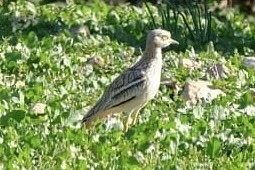
The Eurasian stone-curlew is a fairly large wader, though mid-sized by the standards of its family. Length ranges from 38 to 46 cm (15 to 18 in), wingspan from 76 to 88 cm (30 to 35 in) and weight from 290 to 535 g (10.2 to 18.9 oz). with a strong yellow and black beak, large yellow eyes (which give it a "reptilian", or "goggle-eyed" appearance), and cryptic plumage. The bird is striking in flight, with black and white wing markings.
Text from Wikipedia, licensed CC BY-SA 4.0.
When to see the Eurasian Stone-curlew
One bar for each month. Filled bars are the 8 months with records; pale bars are months with none. The wide bar is May, the month with the most records.
Where to see the Eurasian Stone-curlew
The map shades 59 countries with regular records, and 5 more in a lighter tone where the bird turns up only as a stray. Everything unshaded has no records. Countries are listed below the map.
Recorded as a rare visitor in Germany, Netherlands, Finland, India, Sudan.
About the Eurasian Stone-curlew
The Eurasian stone-curlew, Eurasian thick-knee, or simply stone-curlew is a northern species of the Burhinidae (stone-curlew) bird family.
Text adapted from Wikipedia, licensed CC BY-SA 4.0.
Easily confused with
 Spotted Thick-kneeBurhinus capensisThe spotted thick-knee, which can reach up to 45.5 cm (17.9 in) in height, has long legs and brown-and-white speckled plumage which provides camouflage, making it difficult to spot the bird in the grasslands and savannas where it roams.
 Water Thick-kneeBurhinus vermiculatusThe water thick-knee is 38 to 41 cm (15–16 in) and weighs 293–320 g (10.3–11.3 oz).
 Bush Stone-curlewBurhinus grallariusA species of Burhinus, a genus of large-eyed and long-legged terrestrial foragers known as thick-knees, it is slender in form and a grey and brown colour with distinctive markings.
Side by side: Eurasian Stone-curlew vs Spotted Thick-knee · Eurasian Stone-curlew vs Water Thick-knee · Bush Stone-curlew vs Eurasian Stone-curlew
Learn the Eurasian Stone-curlew in the BeakBrain App
Photo and call practice. Coming soon to iPhone and Android.
Play today's Daily BirdEvery photo and recording on this page is credited to its author under the licence shown. Spotted a problem with this page, or have a better photo? Contribute.