Learn what every symbol on the card means.Full credits and sources at beakbrain.com/symbols
 WoodlandScrapeLarge · 648 g


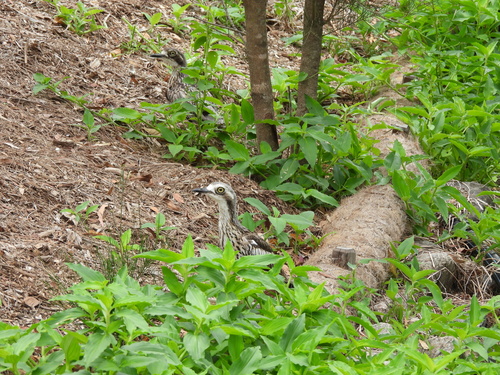
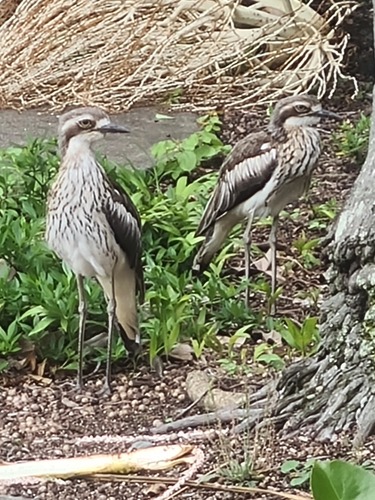
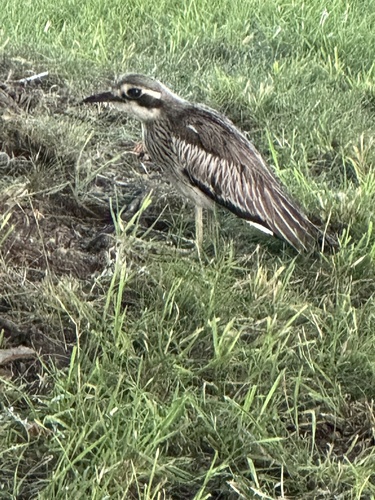
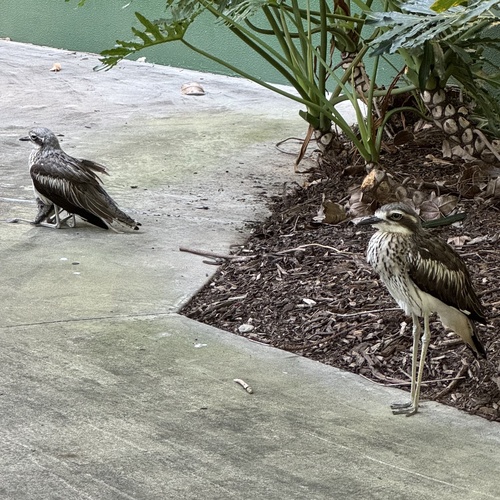
ID tip
A species of Burhinus, a genus of large-eyed and long-legged terrestrial foragers known as thick-knees, it is slender in form and a grey and brown colour with distinctive markings. The bird has conspicuous dark streaks over the buff and greyish white feathers of the upperparts and spotted markings on the wings. The plumage at lower side of the bird is also strongly streaked with dark brown over white and buff feathers. The total length of the species, including a bill around 45 mm and tail 180 mm, is 550 mm; the wingspan approaches 1 m across. Voice: This stone-curlew's voice is loud and can be heard at a great distance. The call of "weeloo" has an eerie and plaintive tone and is a familiar sound of the night in the Australian bush. The frequency of calls increases when weather conditions are changing, especially when rain is approaching an area.
Text from Wikipedia, licensed CC BY-SA 4.0.
When to see the Bush Stone-curlew
One bar for each month, and every month is filled: this bird is recorded here in all twelve. The wide bar is October, the month with the most records.
Where to see the Bush Stone-curlew
The map shades 1 country with regular records, and 1 more in a lighter tone where the bird turns up only as a stray. Everything unshaded has no records. Countries are listed below the map.
Recorded as a rare visitor in Papua New Guinea.
About the Bush Stone-curlew
The bush stone-curlew or bush thick-knee is a large, ground-dwelling bird endemic to Australia. Its favoured habitat is open plains and woodlands, where it stalks slowly at night in search of invertebrates such as insects. Its grey-brown coloration is distinguished by dark streaks, its eyes are large and legs are long. It is capable of flight, but relies on the camouflage of its plumage to evade detection during the day; the bush curlew adopts a rigid posture when it becomes aware of an observer. Both sexes care for two eggs laid on the bare ground, usually sited near bush in a shaded position or next to a fallen branch.
Text adapted from Wikipedia, licensed CC BY-SA 4.0.
Easily confused with
 Water Thick-kneeBurhinus vermiculatusThe water thick-knee is 38 to 41 cm (15–16 in) and weighs 293–320 g (10.3–11.3 oz).
 Indian Stone-curlewBurhinus indicusThis stocky and brown ground bird with large eyes is about 41 centimeters in length.
 Spotted Thick-kneeBurhinus capensisThe spotted thick-knee, which can reach up to 45.5 cm (17.9 in) in height, has long legs and brown-and-white speckled plumage which provides camouflage, making it difficult to spot the bird in the grasslands and savannas where it roams.
Side by side: Bush Stone-curlew vs Eurasian Stone-curlew · Bush Stone-curlew vs Spotted Thick-knee · Bush Stone-curlew vs Water Thick-knee · Bush Stone-curlew vs Indian Stone-curlew · Bush Stone-curlew vs Senegal Thick-knee
Learn the Bush Stone-curlew in the BeakBrain App
Photo and call practice. Coming soon to iPhone and Android.
Play today's Daily BirdEvery photo and recording on this page is credited to its author under the licence shown. Spotted a problem with this page, or have a better photo? Contribute.