Learn what every symbol on the card means.Full credits and sources at beakbrain.com/symbols
 CoastalScrapeLarge · 526 g


What the Eurasian Oystercatcher sounds like


ID tip
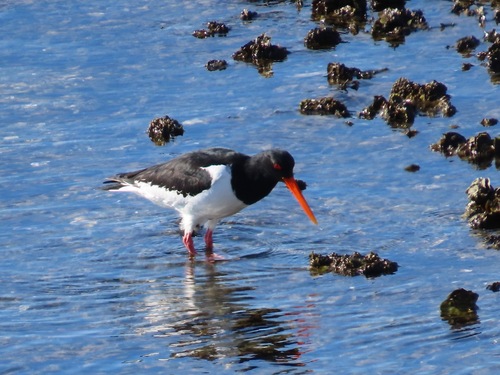
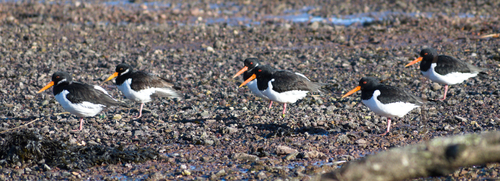
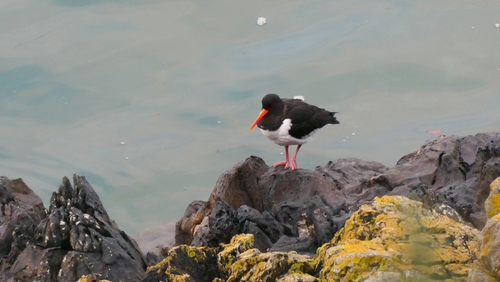
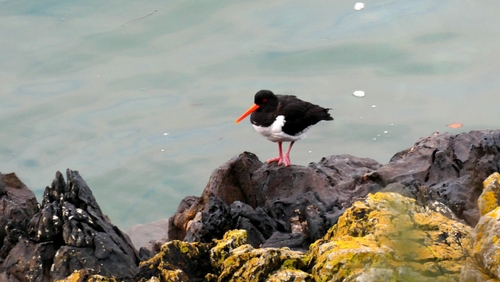
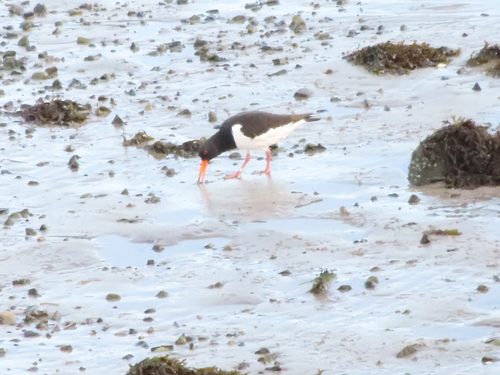
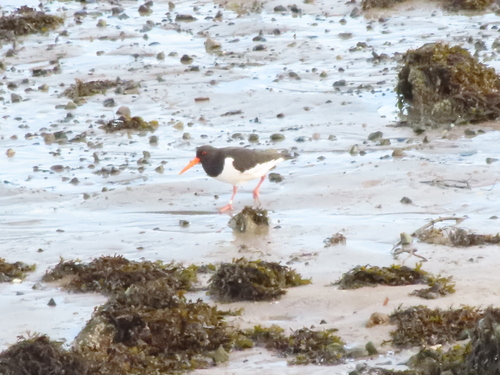
The oystercatcher is one of the largest waders in the region. It is 40–45 cm (16–18 in) long, the bill accounting for 8–9 cm (3–3+1⁄2 in), and has a wingspan of 80–85 cm (31–33 in). It is an obvious and noisy plover-like bird, with black and white plumage, pink legs and a strong broad red bill used for smashing or prising open molluscs such as mussels or for finding earthworms. The sexes are similar in plumage but the female has a longer bill than the male.
Text from Wikipedia, licensed CC BY-SA 4.0.
When to see the Eurasian Oystercatcher
One bar for each month. Filled bars are the 9 months with records; pale bars are months with none. The wide bar is May, the month with the most records.
Where to see the Eurasian Oystercatcher
The map shades 92 countries with regular records, and 10 more in a lighter tone where the bird turns up only as a stray. Everything unshaded has no records. Countries are listed below the map.
Recorded as a rare visitor in Canada, Australia, Mongolia, United States, Libya, Sudan, Vietnam, Lebanon, Turkmenistan, New Zealand.
About the Eurasian Oystercatcher
The Eurasian oystercatcher or European oystercatcher, also known as the common pied oystercatcher, or just oystercatcher, is a wader in the oystercatcher bird family Haematopodidae. It has striking black and white plumage, a long straight orange-red bill, red eyes and relatively short dull pink legs. The sexes are similar in appearance but the bill of the female is longer than that of the male.
Text adapted from Wikipedia, licensed CC BY-SA 4.0.
Easily confused with
 American OystercatcherHaematopus palliatusThe American oystercatcher has distinctive black and white plumage and a long, bright orange beak.
 Black OystercatcherHaematopus bachmaniThe black oystercatcher is a large shorebird, with a black head, neck and breast and dark brown body, a long (9 cm (3.5 in)) bright red/orange bill and pink legs.
 Pied OystercatcherHaematopus longirostrisThe name "oystercatcher" is something of a misnomer for this species, because they seldom eat oysters, which are found mainly on rocky coastlines.
Side by side: American Oystercatcher vs Eurasian Oystercatcher · Black Oystercatcher vs Eurasian Oystercatcher · Eurasian Oystercatcher vs Pied Oystercatcher
Learn the Eurasian Oystercatcher in the BeakBrain App
Photo and call practice. Coming soon to iPhone and Android.
Play today's Daily BirdEvery photo and recording on this page is credited to its author under the licence shown. Spotted a problem with this page, or have a better photo? Contribute.