Learn what every symbol on the card means.Full credits and sources at beakbrain.com/symbols
 CoastalScrapeLarge · 601 g



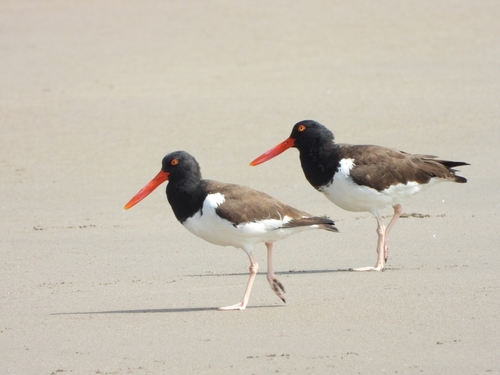
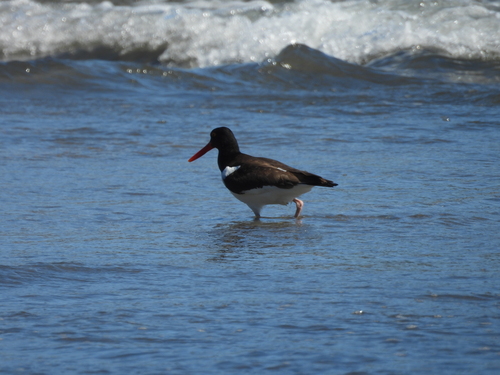
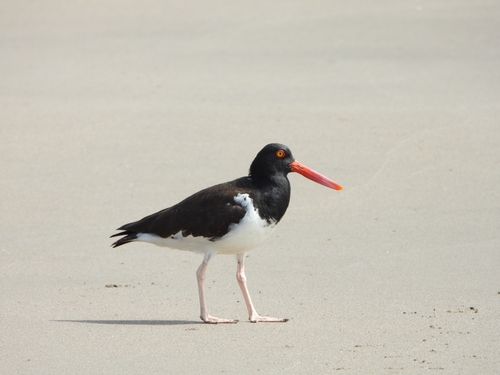
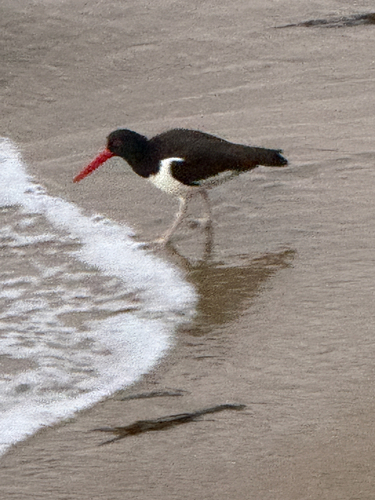
ID tip
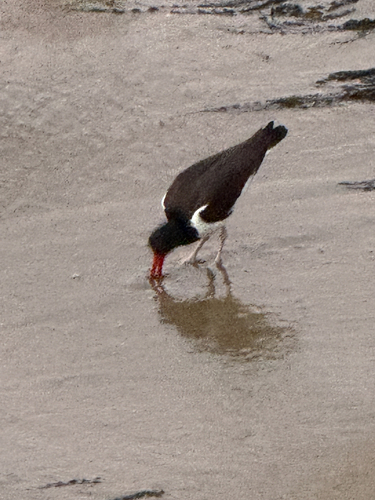
The American oystercatcher has distinctive black and white plumage and a long, bright orange beak. The head and breast are black and the back, wings and tail greyish-black. The underparts are white, as are feathers on the inner part of the wing which become visible during flight. The irises are yellow and the eyes have orange orbital rings. The legs are pink. Adults are between 42–52 cm (17–20 in) in length.
Text from Wikipedia, licensed CC BY-SA 4.0.
When to see the American Oystercatcher
One bar for each month, and every month is filled: this bird is recorded here in all twelve. The wide bar is May, the month with the most records.
Where to see the American Oystercatcher
The map shades 41 countries with regular records, and 2 more in a lighter tone where the bird turns up only as a stray. Everything unshaded has no records. Countries are listed below the map.
Recorded as a rare visitor in French Guiana, Dominica.
About the American Oystercatcher
The American oystercatcher, occasionally called the American pied oystercatcher, is a member of family Haematopodidae. Originally called the "sea pie", it was renamed in 1731 when naturalist Mark Catesby claimed that he had observed the bird eating oysters. The current population of American oystercatchers is estimated to be 50,000 – 99,999 mature individuals. There are estimated to be 1,500 breeding pairs along the Atlantic and Gulf Coasts of the US. The bird is marked by its black and white body and a long, thick orange beak.
Text adapted from Wikipedia, licensed CC BY-SA 4.0.
Easily confused with
 Black OystercatcherHaematopus bachmaniThe black oystercatcher is a large shorebird, with a black head, neck and breast and dark brown body, a long (9 cm (3.5 in)) bright red/orange bill and pink legs.
 Pied OystercatcherHaematopus longirostrisThe name "oystercatcher" is something of a misnomer for this species, because they seldom eat oysters, which are found mainly on rocky coastlines.
 Variable OystercatcherHaematopus unicolor"Variable" refers to the frontal plumage, which ranges from pied through mottled to all black.
Side by side: American Oystercatcher vs Eurasian Oystercatcher · American Oystercatcher vs Black Oystercatcher · American Oystercatcher vs Pied Oystercatcher · American Oystercatcher vs Variable Oystercatcher
Learn the American Oystercatcher in the BeakBrain App
Photo and call practice. Coming soon to iPhone and Android.
Play today's Daily BirdEvery photo and recording on this page is credited to its author under the licence shown. Spotted a problem with this page, or have a better photo? Contribute.