Learn what every symbol on the card means.Full credits and sources at beakbrain.com/symbols
 WoodlandCup nestMedium · 79 g


What the Eurasian Golden Oriole sounds like


ID tip
The male is striking in the typical oriole black and yellow plumage, but the female is a drabber green bird. Orioles are shy, and even the male is remarkably difficult to see in the dappled yellow and green leaves of the canopy. In flight they look somewhat like a thrush, strong and direct with some shallow dips over longer distances. Its call is a harsh "kweeaahk", but the song is a fluting weela-wee-ooo or or-iii-ole, unmistakable once heard, often with subtle variations between each phrase.
Text from Wikipedia, licensed CC BY-SA 4.0.
When to see the Eurasian Golden Oriole
One bar for each month. Filled bars are the 5 months with records; pale bars are months with none. The wide bar is May, the month with the most records.
Where to see the Eurasian Golden Oriole
The map shades 102 countries with regular records, and 11 more in a lighter tone where the bird turns up only as a stray. Everything unshaded has no records. Countries are listed below the map.
Recorded as a rare visitor in India, Iceland, Burkina Faso, Central African Republic, Guinea, Seychelles, Tajikistan, Gibraltar, Gabon, Mayotte, Sierra Leone.
About the Eurasian Golden Oriole
The Eurasian golden oriole, also known as the common golden oriole, is a species of passerine bird and the only Old World oriole breeding in Northern Hemisphere temperate regions. It is a summer migrant in Europe and the Palearctic and spends the winter season in central and southern Africa.
Text adapted from Wikipedia, licensed CC BY-SA 4.0.
Easily confused with
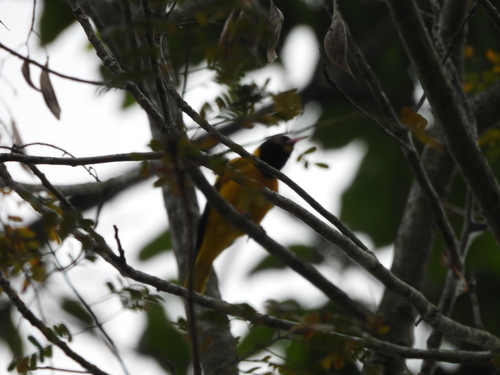 Black-hooded OrioleOriolus xanthornusThe male is striking, with the typical oriole black and yellow colouration.
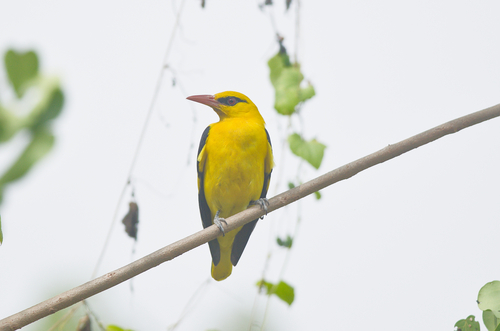 Indian Golden OrioleOriolus kundooThe Indian golden oriole is very similar to the Eurasian golden oriole but has more yellow in the tail and has a paler shade of red in the iris and bill.
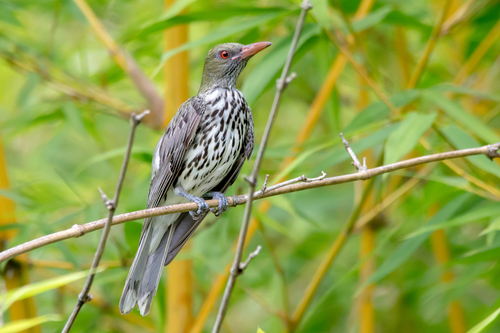 Olive-backed OrioleOriolus sagittatusNot bright in colour, it is olive-backed with small dark streaks, with a light chest having black streaks.
Side by side: Black-hooded Oriole vs Eurasian Golden Oriole · Eurasian Golden Oriole vs Indian Golden Oriole · Eurasian Golden Oriole vs Olive-backed Oriole
Learn the Eurasian Golden Oriole in the BeakBrain App
Photo and call practice. Coming soon to iPhone and Android.
Play today's Daily BirdEvery photo and recording on this page is credited to its author under the licence shown. Spotted a problem with this page, or have a better photo? Contribute.