Learn what every symbol on the card means.Full credits and sources at beakbrain.com/symbols
 WoodlandCup nestMedium · 66 g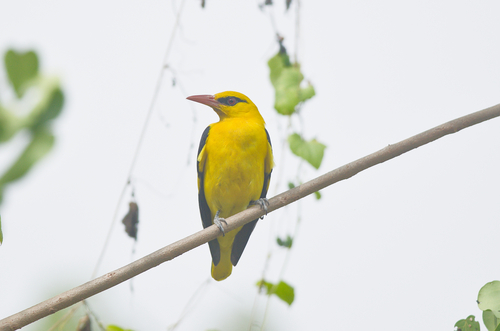


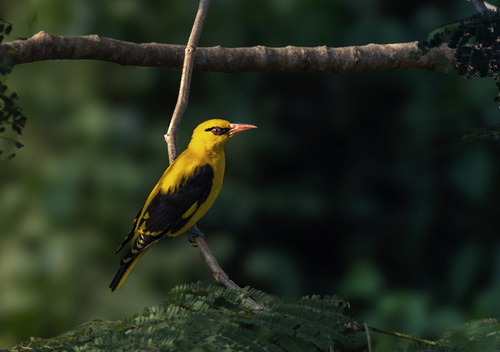
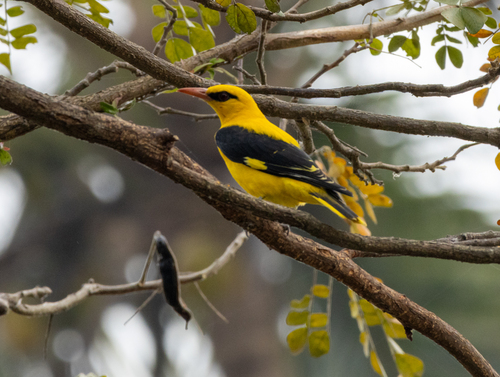
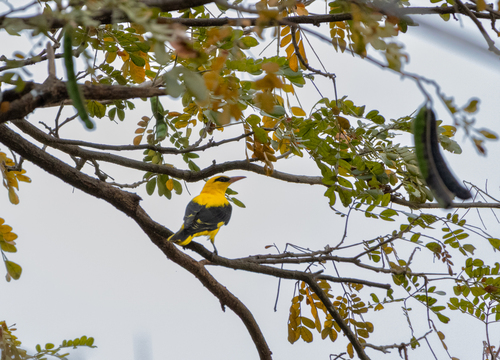
What the Indian Golden Oriole sounds like

ID tip
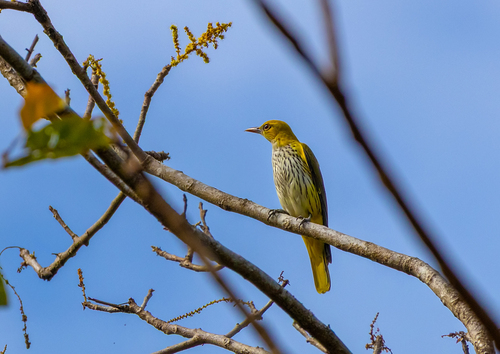
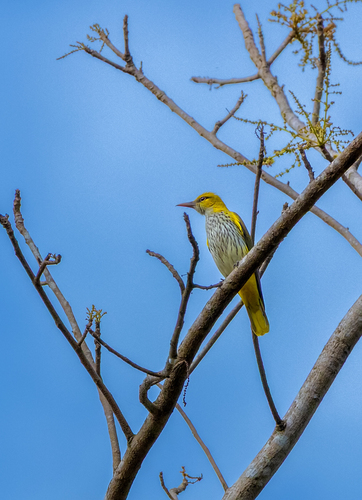
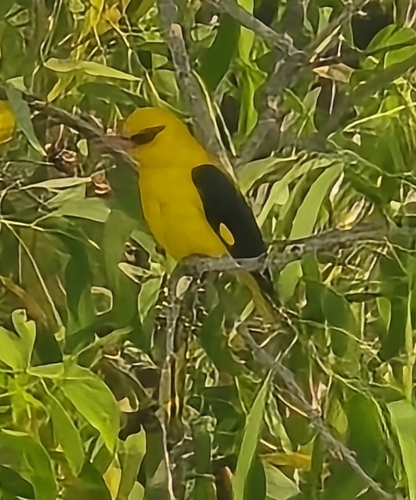
The Indian golden oriole is very similar to the Eurasian golden oriole but has more yellow in the tail and has a paler shade of red in the iris and bill. The male has the black eye stripe extending behind the eye, a large carpal patch on the wing and wide yellow tips to the secondaries and tertiaries. The streaks on the underside of females is more sharp than in the females of the Eurasian golden oriole. The European species is larger with a wing length of 149–162 mm in adult males compared to 136–144 mm in O. kundoo. The wing formula is also different with primary 2 longer than 5 in O.
Text from Wikipedia, licensed CC BY-SA 4.0.
When to see the Indian Golden Oriole
One bar for each month. Filled bars are the 8 months with records; pale bars are months with none. The wide bar is February, the month with the most records.
Where to see the Indian Golden Oriole
The map shades 14 countries with regular records. Everything unshaded has no records. Countries are listed below the map.
About the Indian Golden Oriole
The Indian golden oriole is a species of oriole found in the Indian subcontinent and Central Asia. The species was formerly considered to be a subspecies of the Eurasian golden oriole, but is now considered a full species. Adults can be told apart from the Eurasian golden oriole by the black of the eye stripe extending behind the eye.
Text adapted from Wikipedia, licensed CC BY-SA 4.0.
Easily confused with
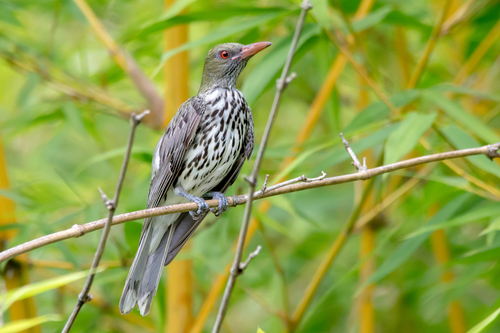 Olive-backed OrioleOriolus sagittatusNot bright in colour, it is olive-backed with small dark streaks, with a light chest having black streaks.
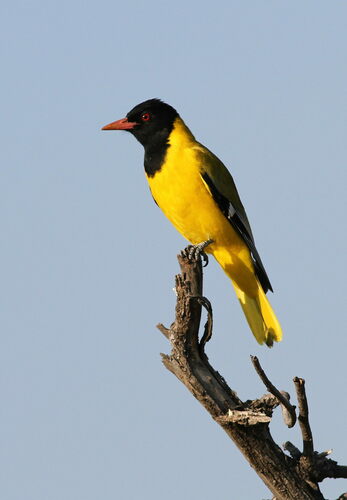 Black-headed OrioleOriolus larvatusThe black-headed oriole has a bright yellow body, contrasting black head and flesh-coloured beak.
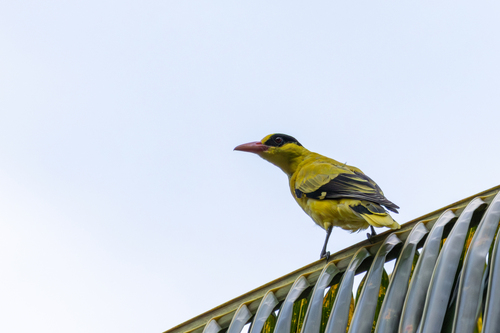 Black-naped OrioleOriolus chinensisThe black-naped oriole is medium-sized and overall golden with a strong pinkish bill and a broad black mask and nape.
Side by side: Eurasian Golden Oriole vs Indian Golden Oriole · Black-hooded Oriole vs Indian Golden Oriole · Indian Golden Oriole vs Olive-backed Oriole · Black-headed Oriole vs Indian Golden Oriole · Black-naped Oriole vs Indian Golden Oriole
Learn the Indian Golden Oriole in the BeakBrain App
Photo and call practice. Coming soon to iPhone and Android.
Play today's Daily BirdEvery photo and recording on this page is credited to its author under the licence shown. Spotted a problem with this page, or have a better photo? Contribute.