Learn what every symbol on the card means.Full credits and sources at beakbrain.com/symbols
 WoodlandPlatform nestHuge · 3.1 kg


ID tip
The eastern imperial eagle is a large eagle, but usually falls near the average size of the large-bodied genus Aquila. Adult total length can range from 68 to 90 cm (27 to 35 in) with a typical wingspan of 1.76 to 2.2 m (5 ft 9 in to 7 ft 3 in). The average wingspan of a small sample showed males to average 1.95 m (6 ft 5 in) while a small sample of females averaged 2.07 m (6 ft 9 in). Although otherwise outwardly similar, the species displays reverse sexual dimorphism as do most birds of prey, in which males are usually smaller than the females. Voice: The eastern imperial eagle is quite vocal on their breeding ground but tends to be silent or nearly so elsewhere. The main call of the species is a deep, harsh bark owk owk, gok gok or kraw-kraw. The call tends to be repeated rapidly up to 8-10 times. Their call is perceptibly deeper and harsher than that of the golden eagle, somewhat incongruously also being more resonant and commanding.
Text from Wikipedia, licensed CC BY-SA 4.0.
When to see the Eastern Imperial Eagle
One bar for each month. Filled bars are the 9 months with records; pale bars are months with none. The wide bar is December, the month with the most records.
Where to see the Eastern Imperial Eagle
The map shades 55 countries with regular records, and 9 more in a lighter tone where the bird turns up only as a stray. Everything unshaded has no records. Countries are listed below the map.
Recorded as a rare visitor in Norway, Finland, Denmark, Netherlands, Portugal, Chad, Tajikistan, Moldova, Spain.
About the Eastern Imperial Eagle
The eastern imperial eagle is a large bird of prey that breeds in southeastern Europe and extensively through West and Central Asia. Most populations are migratory and winter in northeastern Africa, the Middle East and South and East Asia. Like all eagles, the eastern imperial eagle is a member of the family Accipitridae. Furthermore, its feathered legs mark it as a member of the subfamily Aquilinae. It is a large, dark-colored eagle, with a resemblance to other members of the genus Aquila, but it is usually the darkest species in its range.
Text adapted from Wikipedia, licensed CC BY-SA 4.0.
Easily confused with
 Verreaux's EagleAquila verreauxiiVerreaux's eagle is a very large eagle.
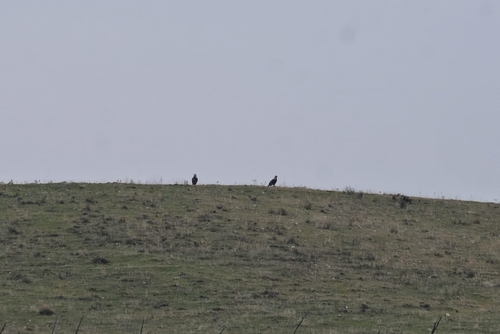 Spanish Imperial EagleAquila adalbertiThis is a large raptor and quite large eagle, broadly similar in size to its cousin, the eastern imperial eagle, which is found in a considerably different distributional range.
 African Hawk-EagleAquila spilogasterThe African hawk-eagle has a somewhat small head but one that protrudes quite well due its quite long neck and relatively prominent beak.
Side by side: Bonelli's Eagle vs Eastern Imperial Eagle · Eastern Imperial Eagle vs Tawny Eagle · Eastern Imperial Eagle vs Steppe Eagle · Eastern Imperial Eagle vs Verreaux's Eagle · Eastern Imperial Eagle vs Spanish Imperial Eagle · African Hawk-Eagle vs Eastern Imperial Eagle
Learn the Eastern Imperial Eagle in the BeakBrain App
Photo and call practice. Coming soon to iPhone and Android.
Play today's Daily BirdEvery photo and recording on this page is credited to its author under the licence shown. Spotted a problem with this page, or have a better photo? Contribute.