Learn what every symbol on the card means.Full credits and sources at beakbrain.com/symbols
 GrasslandPlatform nestLarge · 1.5 kg


ID tip
The African hawk-eagle has a somewhat small head but one that protrudes quite well due its quite long neck and relatively prominent beak. Furthermore, the species possesses a longish tail, with long and somewhat slender feathered legs and has large, robust feet. Although African hawk-eagles occasionally take to perching in the open, they usually are somewhat obscured for much of the day within the cover of foliage and often perch relatively low down in tall trees. The wing tips tend to fall a bit short of the tail tip. Voice: The African hawk-eagle is generally silent outside breeding season. Its main call is melodious fluting klooee. The call is perhaps most often recorded in contact between pair members. The call is sometimes considered not unlike that of the often sympatric Wahlberg's eagle (Hieraaetus wahlbergi) but that of the African hawk-eagle tends to be less drawn out and more mellow in tone.
Text from Wikipedia, licensed CC BY-SA 4.0.
When to see the African Hawk-Eagle
One bar for each month, and every month is filled: this bird is recorded here in all twelve. The wide bar is November, the month with the most records.
Where to see the African Hawk-Eagle
The map shades 28 countries with regular records, and 2 more in a lighter tone where the bird turns up only as a stray. Everything unshaded has no records. Countries are listed below the map.
Recorded as a rare visitor in Burkina Faso, Côte d’Ivoire.
About the African Hawk-Eagle
The African hawk-eagle is a large bird of prey. Like all eagles, it belongs to the family Accipitridae. This species' feathered legs mark it as a member of the Aquilinae subfamily. The African hawk-eagle breeds in tropical Sub-Saharan Africa. It is a bird of assorted woodland, including both savanna and hilly areas, but they tend to occur in woodland that is typically dry. The species tends to be rare in areas where their preferred habitat type is absent. This species builds a stick nest of around 1 m (3.3 ft) across in a large tree. The clutch is generally one or two eggs.
Text adapted from Wikipedia, licensed CC BY-SA 4.0.
Easily confused with
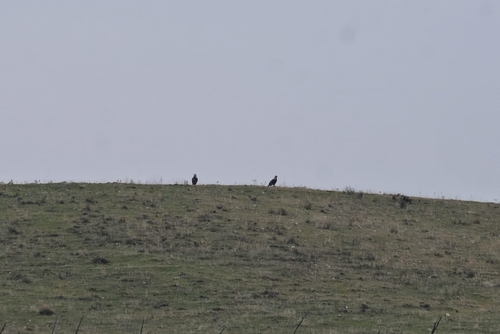 Spanish Imperial EagleAquila adalbertiThis is a large raptor and quite large eagle, broadly similar in size to its cousin, the eastern imperial eagle, which is found in a considerably different distributional range.
 Verreaux's EagleAquila verreauxiiVerreaux's eagle is a very large eagle.
 Eastern Imperial EagleAquila heliacaThe eastern imperial eagle is a large eagle, but usually falls near the average size of the large-bodied genus Aquila.
Side by side: African Hawk-Eagle vs Eastern Imperial Eagle · African Hawk-Eagle vs Verreaux's Eagle · African Hawk-Eagle vs Spanish Imperial Eagle · African Hawk-Eagle vs Pearl Kite · African Hawk-Eagle vs Lappet-faced Vulture
Learn the African Hawk-Eagle in the BeakBrain App
Photo and call practice. Coming soon to iPhone and Android.
Play today's Daily BirdEvery photo and recording on this page is credited to its author under the licence shown. Spotted a problem with this page, or have a better photo? Contribute.