Learn what every symbol on the card means.Full credits and sources at beakbrain.com/symbols
 Shrubland15 g


What the Common Whitethroat sounds like


ID tip
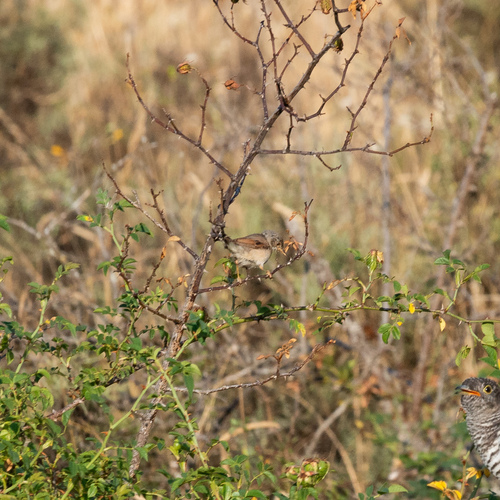
This is one of several Curruca species that has distinct male and female plumages. Both sexes are mainly brown above and buff below, with chestnut fringes to the secondary remiges. The adult male has a grey head and a white throat. The female lacks the grey head, and the throat is duller. The whitethroat's song is fast and scratchy, with a scolding tone. The hoarse, slightly nasal, call sounds like wed-wed or woid-woid. The warning cry is long-pulled, rough tschehr which resembles that of the Dartford warbler.
Text from Wikipedia, licensed CC BY-SA 4.0.
When to see the Common Whitethroat
One bar for each month. Filled bars are the 6 months with records; pale bars are months with none. The wide bar is May, the month with the most records.
Where to see the Common Whitethroat
The map shades 108 countries with regular records, and 7 more in a lighter tone where the bird turns up only as a stray. Everything unshaded has no records. Countries are listed below the map.
Recorded as a rare visitor in Japan, Guinea, Mali, Central African Republic, Liberia, Mozambique, San Marino.
About the Common Whitethroat
The common whitethroat or greater whitethroat is a common and widespread Old World warbler which breeds throughout Europe and across much of temperate western Asia. This small passerine bird is strongly migratory, and winters in tropical Africa, Arabia, and Pakistan.
Text adapted from Wikipedia, licensed CC BY-SA 4.0.
Easily confused with
 Lesser WhitethroatCurruca currucaThe lesser whitethroat is a common and widespread Old World warbler which breeds in temperate Europe, except the southwest, and in the western and central Palearctic.
Sardinian WarblerCurruca melanocephalaThe Sardinian warbler is a common and widespread Sylviidae warbler from the Mediterranean region.
Lesser WhitethroatCurruca currucaThe lesser whitethroat is a common and widespread Old World warbler which breeds in temperate Europe, except the southwest, and in the western and central Palearctic.
Sardinian WarblerCurruca melanocephalaThe Sardinian warbler is a common and widespread Sylviidae warbler from the Mediterranean region.
 Dartford WarblerCurruca undataThe Dartford warbler is a small, 13 cm (5.1 in), passerine bird, distinguished by its long tail compared with that of other warblers.
Side by side: Common Whitethroat vs Dartford Warbler
Learn the Common Whitethroat in the BeakBrain App
Photo and call practice. Coming soon to iPhone and Android.
Play today's Daily BirdEvery photo and recording on this page is credited to its author under the licence shown. Spotted a problem with this page, or have a better photo? Contribute.