Learn what every symbol on the card means.Full credits and sources at beakbrain.com/symbols
 Shrubland12 g


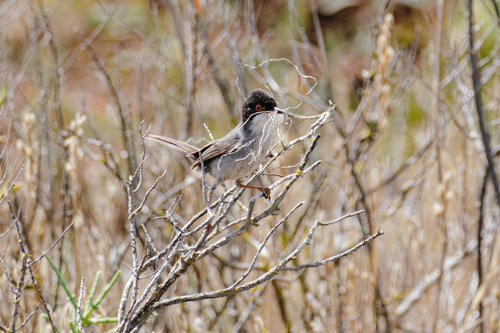
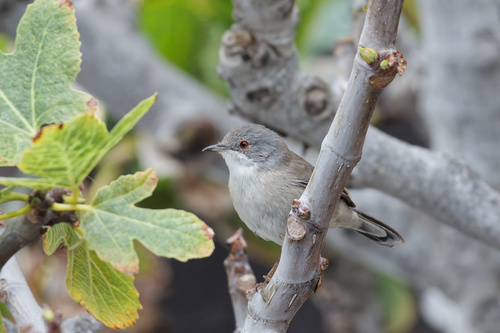
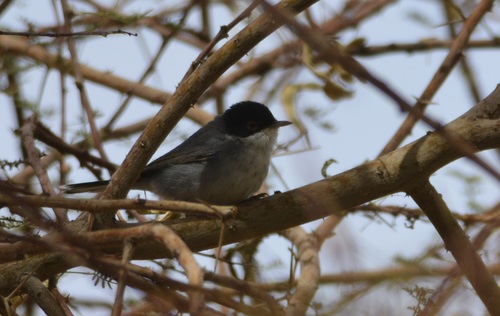
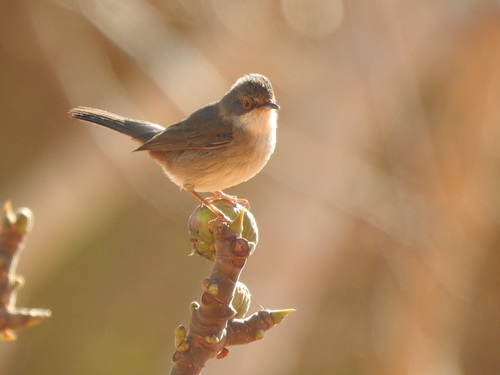
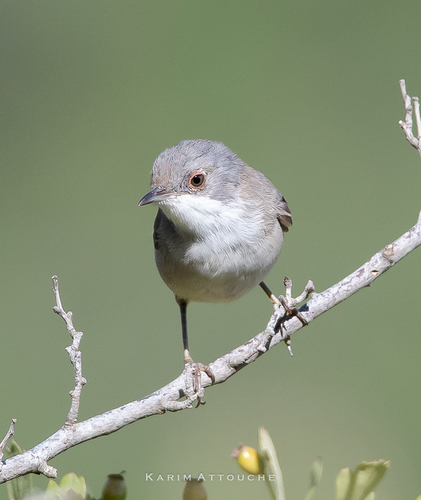
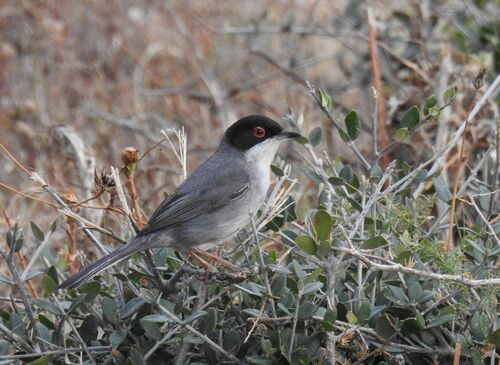
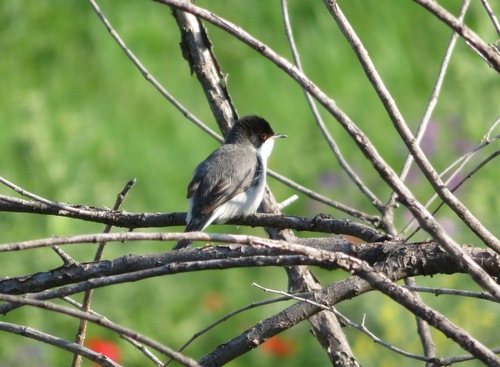
What the Sardinian Warbler sounds like


When to see the Sardinian Warbler
One bar for each month, and every month is filled: this bird is recorded here in all twelve. The wide bar is April, the month with the most records.
Where to see the Sardinian Warbler
The map shades 40 countries with regular records, and 8 more in a lighter tone where the bird turns up only as a stray. Everything unshaded has no records. Countries are listed below the map.
Recorded as a rare visitor in Norway, Finland, Denmark, Ireland, Germany, Belgium, Sudan, Luxembourg.
About the Sardinian Warbler
The Sardinian warbler is a common and widespread Sylviidae warbler from the Mediterranean region. Like most Curruca species, it has distinct male and female plumages. The adult male has a grey back, whitish underparts, black head, white throat and red eyes. Plumages are somewhat variable even in the same locality, with the intensity of a reddish hue on upper- and/or underside that varies from absent to pronounced. The female is mainly brown above and buff below, with a grey head. The Sardinian warbler's song is fast and rattling, and is very characteristic of the Mediterranean areas where this bird breeds.
Text adapted from Wikipedia, licensed CC BY-SA 4.0.
Easily confused with
Lesser WhitethroatCurruca currucaThe lesser whitethroat is a common and widespread Old World warbler which breeds in temperate Europe, except the southwest, and in the western and central Palearctic.
 Common WhitethroatCurruca communisThis is one of several Curruca species that has distinct male and female plumages.
 Dartford WarblerCurruca undataThe Dartford warbler is a small, 13 cm (5.1 in), passerine bird, distinguished by its long tail compared with that of other warblers.
Learn the Sardinian Warbler in the BeakBrain App
Photo and call practice. Coming soon to iPhone and Android.
Play today's Daily BirdEvery photo and recording on this page is credited to its author under the licence shown. Spotted a problem with this page, or have a better photo? Contribute.