Learn what every symbol on the card means.Full credits and sources at beakbrain.com/symbols
 UrbanCavity nestSmall · 38 g




What the Common Swift sounds like


ID tip
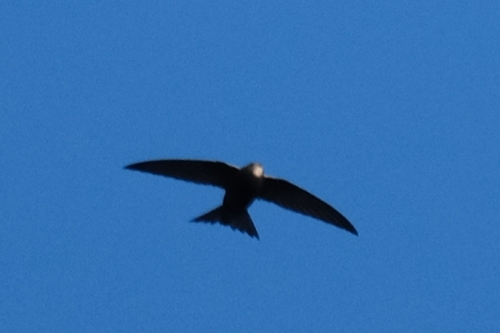
Common swifts are 16–17 cm (6.3–6.7 in) long with a wingspan of 38–40 cm (15–16 in) and entirely blackish-brown except for a small white or pale grey patch on their chins which is not visible from a distance. They have a short forked tail and very long swept-back wings that resemble a crescent or a boomerang. Their call is a loud scream in two different tone pitches, the higher of which issues from the female. They often form "screaming parties" during summer evenings, when 10–20 swifts will gather in flight around their nesting area, calling out and being answered by nesting swifts.
Text from Wikipedia, licensed CC BY-SA 4.0.
When to see the Common Swift
One bar for each month. Filled bars are the 5 months with records; pale bars are months with none. The wide bar is May, the month with the most records.
Where to see the Common Swift
The map shades 135 countries with regular records, and 5 more in a lighter tone where the bird turns up only as a stray. Everything unshaded has no records. Countries are listed below the map.
Recorded as a rare visitor in United States, Canada, South Sudan, Bermuda, Brazil.
About the Common Swift
The common swift is a medium-sized bird, superficially similar to the barn swallow or house martin but somewhat larger, though not stemming from those passerine species, being in the order Apodiformes. The resemblances between the groups are due to convergent evolution, reflecting similar contextual development. The swifts' nearest relatives are the New World hummingbirds and the Southeast Asian treeswifts.
Text adapted from Wikipedia, licensed CC BY-SA 4.0.
Easily confused with
 Little SwiftApus affinisLittle swifts are readily identified by their small size.
 House SwiftApus nipalensisThe house swift looks quite similar to the little swift.
 White-rumped SwiftApus cafferThis 14–15.5 cm (5.5–6.1 in) long species has, like some relatives, a short forked tail and long swept-back wings that resemble a crescent or a boomerang.
Side by side: Common Swift vs Little Swift · Common Swift vs House Swift · Common Swift vs White-rumped Swift
Watch the Common Swift on live cams
Browse all 118 bird cams worldwide, live and seasonal, by region and species.
Learn the Common Swift in the BeakBrain App
Photo and call practice. Coming soon to iPhone and Android.
Play today's Daily BirdEvery photo and recording on this page is credited to its author under the licence shown. Spotted a problem with this page, or have a better photo? Contribute.