Learn what every symbol on the card means.Full credits and sources at beakbrain.com/symbols
 WetlandScrapeMedium · 113 g

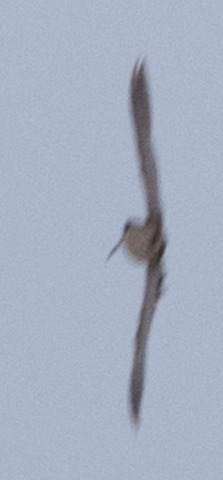
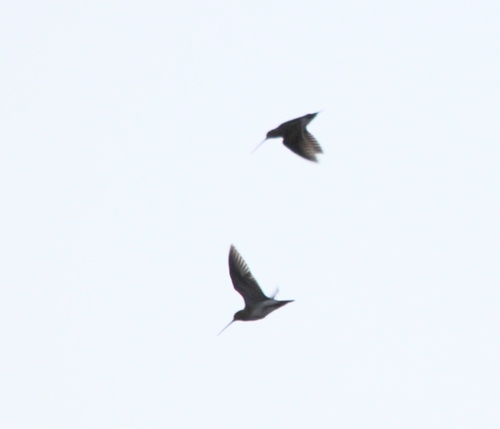
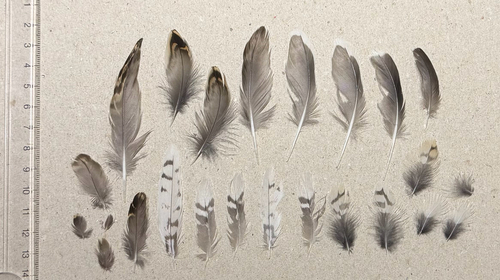
What the Common Snipe sounds like


ID tip
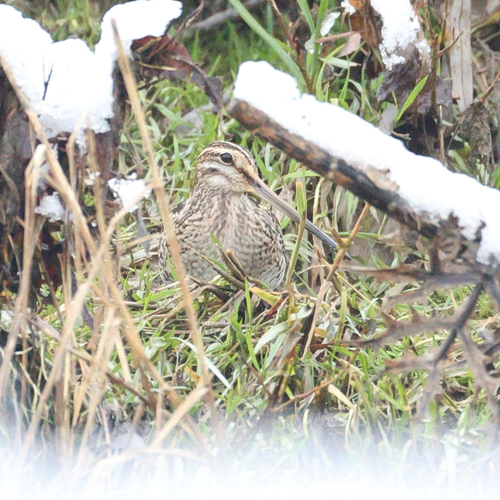
Adults are 25–27 cm (9.8–10.6 in) in length with a 44–47 cm (17–19 in) wingspan and a weight of 80–140 g (2.8–4.9 oz) (up to 180 g (6.3 oz) pre-migration). They have short greenish-grey legs and a very long (5.5–7 cm (2.2–2.8 in)) straight dark bill. The body is mottled brown with straw-yellow stripes on top and pale underneath. They have a dark stripe through the eye, with light stripes above and below it. The wings are pointed. The common snipe is the most widespread of several similar snipes. It most closely resembles the Wilson's snipe (G.
Text from Wikipedia, licensed CC BY-SA 4.0.
When to see the Common Snipe
One bar for each month, and every month is filled: this bird is recorded here in all twelve. The wide bar is April, the month with the most records.
Where to see the Common Snipe
The map shades 132 countries with regular records, and 9 more in a lighter tone where the bird turns up only as a stray. Everything unshaded has no records. Countries are listed below the map.
Recorded as a rare visitor in Canada, Mexico, Liberia, Zambia, Turkmenistan, Equatorial Guinea, Guadeloupe, Maldives, North Korea.
About the Common Snipe
The common snipe is a small, stocky wader native to the Old World, where it breeds in marshes, bogs, tundra and wet meadows. It is usually shy and well-camouflaged, foraging in soft mud mainly for insects and earthworms but also some plant material. During courtship, males perform a "winnowing" display; flying high in circles and then taking shallow dives to produce a "drumming" sound by vibrating the tail feathers.
Text adapted from Wikipedia, licensed CC BY-SA 4.0.
Easily confused with
Wilson's SnipeGallinago delicataAdults are 23–28 cm (9.1–11.0 in) in length with a 39–45 cm (15–18 in) wingspan.
 Latham's SnipeGallinago hardwickiiThe snipe is 29–33 cm long, with a wingspan of 50–54 cm and weight of 150–230 g.
 Great SnipeGallinago mediaAt 26–30 cm (10–12 in) in length and a 42–50 cm (17–20 in) wingspan, adults are only slightly larger, but much bulkier, than the common snipe and have a shorter bill.
Side by side: Common Snipe vs Wilson's Snipe · Common Snipe vs Latham's Snipe · Common Snipe vs Great Snipe
Learn the Common Snipe in the BeakBrain App
Photo and call practice. Coming soon to iPhone and Android.
Play today's Daily BirdEvery photo and recording on this page is credited to its author under the licence shown. Spotted a problem with this page, or have a better photo? Contribute.