Common Sandpiper

Actitis hypoleucos

Sandpipers and Allies · Charadriiformes · Common

The Common Sandpiper (Actitis hypoleucos) is a common sandpiper found in 164 countries, weighing about 48 g. The common sandpiper is a small Palearctic wader.

Least ConcernCommonEats invertebrateswetlandplatform nest48 g

About the Common Sandpiper

The common sandpiper is a small Palearctic wader. This bird and its American sister species, the spotted sandpiper, make up the genus Actitis. They are parapatric and replace each other geographically; stray birds of either species may settle down with breeders of the other and hybridize. Hybridization has also been reported between the common sandpiper and the green sandpiper, a member of the closely related genus Tringa.

Text adapted from Wikipedia, licensed CC BY-SA 4.0.

How to identify it

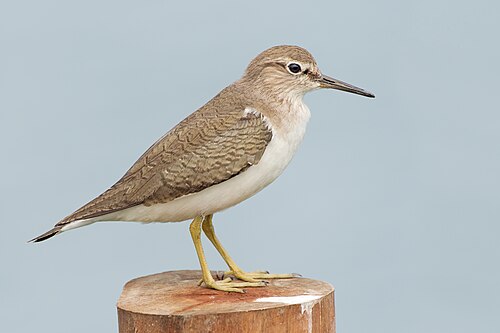
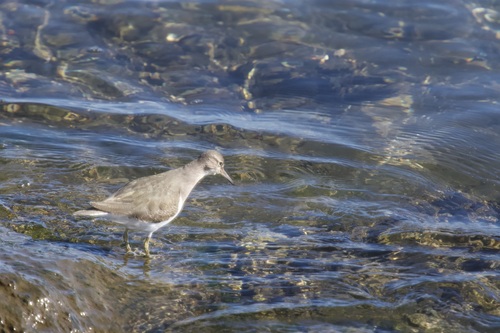
The adult is 18–20 cm (7.1–7.9 in) long with a 32–35 cm (13–14 in) wingspan. It has greyish-brown upperparts, white underparts, short dark-yellowish legs and feet, and a bill with a pale base and dark tip. In winter plumage, they are duller and have more conspicuous barring on the wings, though this is still only visible at close range. Juveniles are more heavily barred above and have buff edges to the wing feathers. This species is very similar to the slightly larger spotted sandpiper (A. macularia) in non-breeding plumage.

What the Common Sandpiper sounds like

Recording: Lionel Triboulin · CC0 · via xeno-canto
Recording: Philippe_Grange · CC0 · via xeno-canto

Where it lives

Sweden India Spain Norway Taiwan France United Kingdom Portugal Belgium Finland South Africa Australia Germany Israel Japan United Arab Emirates Thailand China Kenya Hong Kong SAR China Malaysia Türkiye Singapore Italy Philippines Poland Indonesia Sri Lanka Czechia Greece Austria Netherlands Russia Oman Tanzania South Korea Uganda Nepal Switzerland Morocco Ireland Namibia Botswana Gambia Senegal Zimbabwe Denmark Ethiopia Iran Croatia Zambia Ghana Hungary Cyprus Bangladesh Madagascar Mongolia Bulgaria Ukraine Cambodia Slovenia Georgia Bhutan Saudi Arabia Egypt Serbia Vietnam Estonia Slovakia Kuwait Papua New Guinea Mozambique Romania Belarus Palau Rwanda Nigeria Kazakhstan Pakistan Timor-Leste Lithuania Myanmar (Burma) Malawi Qatar Eswatini Congo - Kinshasa Laos Kyrgyzstan Cape Verde Latvia Luxembourg Malta Northern Mariana Islands Isle of Man Tunisia Réunion Cameroon Guinea-Bissau Azerbaijan Maldives Jordan Gabon Moldova Djibouti Benin Algeria Albania Macao SAR China São Tomé & Príncipe Côte d’Ivoire Angola Armenia Tajikistan Montenegro Seychelles Yemen Lebanon Uzbekistan Liberia Palestinian Territories Guam Bahrain Brunei Equatorial Guinea Iraq Mauritania Congo - Brazzaville Solomon Islands Jersey Togo Sierra Leone Guinea North Macedonia Mayotte Sudan Bosnia & Herzegovina Gibraltar Burkina Faso Mauritius Libya Chad Afghanistan Kosovo Mali Somalia Niger Guernsey Central African Republic Eritrea Burundi Comoros Micronesia North Korea South Sudan Syria Lesotho Turkmenistan Andorra New Caledonia Vanuatu Iceland Samoa

Recorded as a rare visitor in United States, New Zealand.

When to see it

The Common Sandpiper can be seen all year round, with peak activity in May. It is a resident species across most of its range.

Easily confused with

Quick questions

How do you identify a Common Sandpiper?
The adult is 18–20 cm (7.1–7.9 in) long with a 32–35 cm (13–14 in) wingspan. Full identification notes are on this page.
How big is a Common Sandpiper?
The Common Sandpiper is a small sized bird weighing about 48 g.
Where can you see a Common Sandpiper?
The Common Sandpiper occurs in 164 countries, including Sweden, India, Spain, Norway and Taiwan.
What does a Common Sandpiper sound like?
You can listen to 3 field recordings of the Common Sandpiper on this page, contributed to xeno-canto under open licences.
What birds look similar to a Common Sandpiper?
The Common Sandpiper is most easily confused with the Spotted Sandpiper.
Is the Common Sandpiper endangered?
The Common Sandpiper is listed as Least Concern on the IUCN Red List.

Learn the Common Sandpiper for real

BeakBrain drills you on photos and calls until you can greet this bird by name in the field. Free to play, on any device.

Play BeakBrain

Every photo and recording on this page is credited to its author under the licence shown. Spotted a problem with this page, or have a better photo? Contribute.