Learn what every symbol on the card means.Full credits and sources at beakbrain.com/symbols
 UrbanScrapeLarge · 1.1 kg


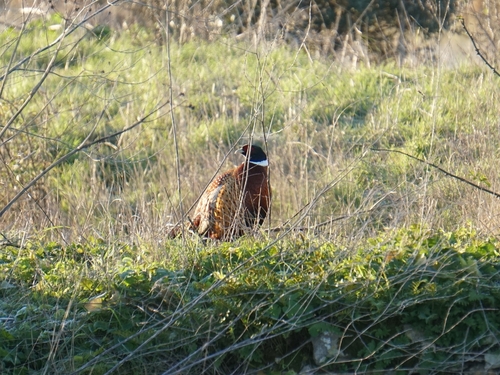
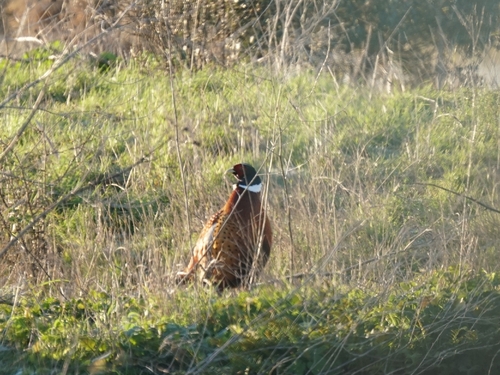
What the Common Pheasant sounds like


ID tip
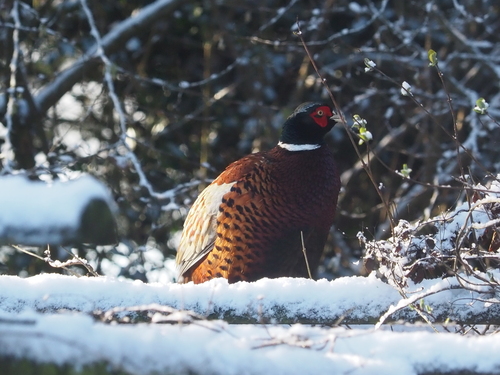
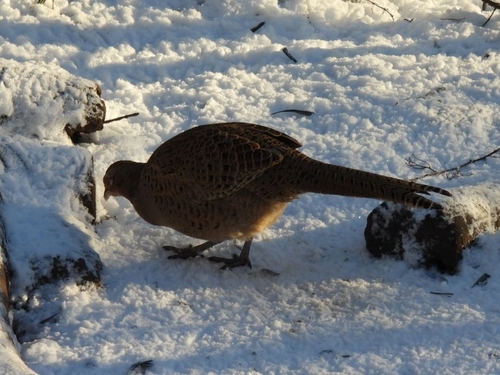
There are many colour forms of the male common pheasant, ranging in colour from nearly white to almost black in some melanistic examples. These are due to captive breeding and hybridisation between subspecies and with the green pheasant, reinforced by continual releases of stock from varying sources to the wild. For example, the "ring-necked pheasants" common in Europe, North America and Australia do not pertain to any specific taxon, they rather represent a stereotyped hybrid swarm. Body weight can range from 0.5 to 3 kg (1 to 7 lb), with males averaging 1.
Text from Wikipedia, licensed CC BY-SA 4.0.
When to see the Common Pheasant
One bar for each month. Filled bars are the 11 months with records; pale bars are months with none. The wide bar is May, the month with the most records.
Where to see the Common Pheasant
The map shades 77 countries with regular records, and 7 more in a lighter tone where the bird turns up only as a stray. Everything unshaded has no records. Countries are listed below the map.
Recorded as a rare visitor in Argentina, Morocco, Algeria, Bermuda, Guadeloupe, St. Barthélemy, Liechtenstein.
About the Common Pheasant
The common pheasant, ring-necked pheasant, or blue-headed pheasant, is a bird in the pheasant family (Phasianidae). The genus name comes from Latin phasianus 'pheasant'. The species name colchicus is Latin for 'of Colchis', a country on the Black Sea where pheasants became known to Europeans. Although Phasianus was previously thought to be closely related to the genus Gallus, the genus of junglefowl and domesticated chickens, recent studies show that they are in different subfamilies, having diverged over 20 million years ago.
Text adapted from Wikipedia, licensed CC BY-SA 4.0.
Easily confused with

Side by side: Common Pheasant vs Green Pheasant
Learn the Common Pheasant in the BeakBrain App
Photo and call practice. Coming soon to iPhone and Android.
Play today's Daily BirdEvery photo and recording on this page is credited to its author under the licence shown. Spotted a problem with this page, or have a better photo? Contribute.