Learn what every symbol on the card means.Full credits and sources at beakbrain.com/symbols
 UrbanScrapeLarge · 919 g




ID tip
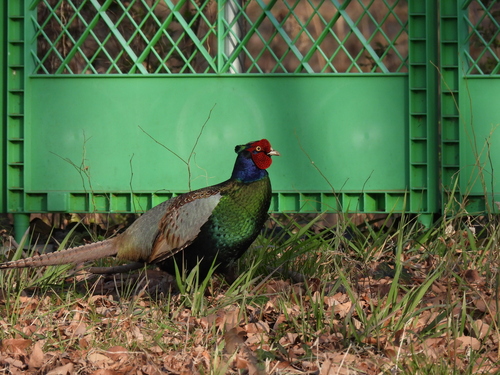
The male (cock) southern green pheasant, P. v. versicolor, has dark green plumage on the breast, neck, mantle, and flanks. The male also has a bluish-purplish hood with clear ear tufts, red wattles, and a long, pale grey-banded tail. The female (hen) is smaller than the male, with a shorter tail, and has brownish-black colored plumage, with dark brown feathers fringed pale brown. The males of this subspecies have the darkest plumage, which is mainly green. The male Pacific green pheasant, P. v. tamensis, has lighter plumage than the nominate subspecies. Its feathers are more purple and blue.
Text from Wikipedia, licensed CC BY-SA 4.0.
When to see the Green Pheasant
One bar for each month. Filled bars are the 9 months with records; pale bars are months with none. The wide bar is April, the month with the most records.
Where to see the Green Pheasant
The map shades 1 country with regular records, and 5 more in a lighter tone where the bird turns up only as a stray. Everything unshaded has no records. Countries are listed below the map.
Recorded as a rare visitor in United States, France, Belgium, Italy, United Kingdom.
About the Green Pheasant
The green pheasant, also known as the Japanese green pheasant or Kiji, is an omnivorous bird native to the Japanese archipelago, to which it is endemic. Some taxonomic authorities consider it a subspecies of the common pheasant, Phasianus colchicus. It is the national bird of Japan.
Text adapted from Wikipedia, licensed CC BY-SA 4.0.
Easily confused with

Side by side: Common Pheasant vs Green Pheasant
Learn the Green Pheasant in the BeakBrain App
Photo and call practice. Coming soon to iPhone and Android.
Play today's Daily BirdEvery photo and recording on this page is credited to its author under the licence shown. Spotted a problem with this page, or have a better photo? Contribute.