Learn what every symbol on the card means.Full credits and sources at beakbrain.com/symbols
 WoodlandCavity nestSmall · 29 g


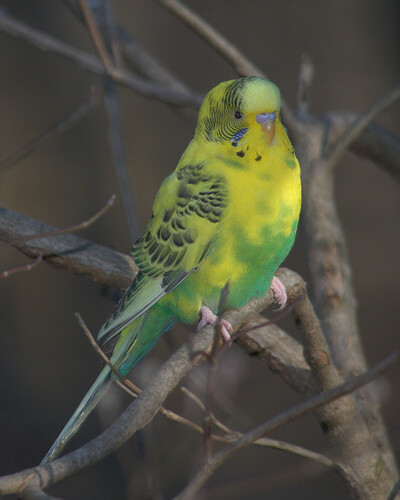
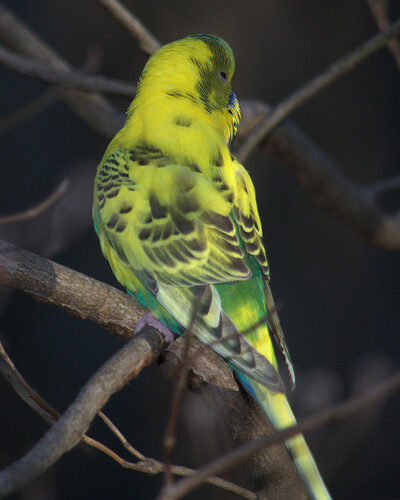


What the Budgerigar sounds like

ID tip
Wild budgerigars average 18 cm (7 in) long, weigh 30–40 grams (1.1–1.4 oz), 30 cm (12 in) in wingspan, and display a light green body colour, while their mantles display pitch-black mantle markings (blackish in fledglings and immatures) edged in clear yellow undulations. The forehead and face is yellow in adults. Prior to their adult plumage, young individuals have blackish stripes down to the cere in young individuals until around 3–4 months of age. They display small, iridescent blue-violet cheek patches and a series of three black spots across each side of their throat.
Text from Wikipedia, licensed CC BY-SA 4.0.
When to see the Budgerigar
One bar for each month. Filled bars are the 10 months with records; pale bars are months with none. The wide bar is September, the month with the most records.
Where to see the Budgerigar
The map shades 44 countries with regular records, and 33 more in a lighter tone where the bird turns up only as a stray. Everything unshaded has no records. Countries are listed below the map.
Recorded as a rare visitor in Canada, Belgium, United Kingdom, India, South Africa, New Zealand, Brazil, Colombia, Peru, Morocco, Panama, Türkiye, Ecuador, Netherlands, Switzerland, Poland, Costa Rica, Honduras, Norway, Curaçao, Austria, Bulgaria, Cyprus, Hungary, North Macedonia, Egypt, Jamaica, Martinique, Venezuela, Cambodia, Denmark, Croatia, Russia.
About the Budgerigar
The budgerigar, also known as the common parakeet, shell parakeet or budgie, is a small, long-tailed, seed-eating parrot native to Australia. Naturally, the species is green and yellow with black, scalloped markings on the nape, back, and wings. Budgies are bred in captivity with colouring of blues, whites, yellows, greys, and even with small crests. Juveniles and chicks are monomorphic, while adults are told apart by their cere colouring and their behaviour.
Text adapted from Wikipedia, licensed CC BY-SA 4.0.
Easily confused with
 Blue-winged ParakeetPsittacula columboidesThe blue-winged parakeet is bluish grey with a long yellow-tipped tail.
 Rosy-faced LovebirdAgapornis roseicollisThe rosy-faced lovebird is a fairly small bird, 17–18 cm (6.7–7.1 in) long, with an average wing length of 106 mm (4.2 in) and tail length of 44–52 mm (1.7–2.0 in).
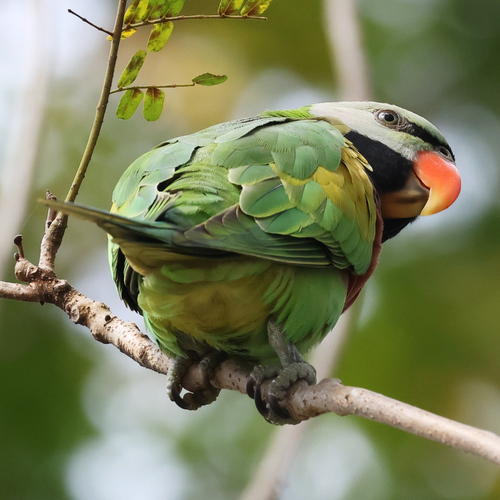 Red-breasted ParakeetPsittacula alexandriThe red-breasted parakeet is a parrot native to Southeast Asia.
Side by side: Blue-winged Parakeet vs Budgerigar · Budgerigar vs Rosy-faced Lovebird
Learn the Budgerigar in the BeakBrain App
Photo and call practice. Coming soon to iPhone and Android.
Play today's Daily BirdEvery photo and recording on this page is credited to its author under the licence shown. Spotted a problem with this page, or have a better photo? Contribute.