Learn what every symbol on the card means.Full credits and sources at beakbrain.com/symbols
 MarinePlatform nestHuge · 3.4 kg


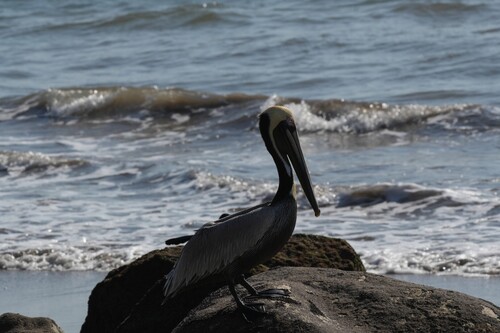
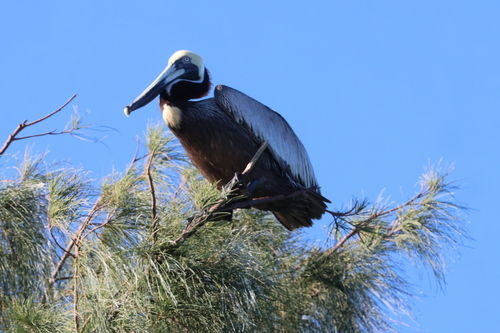


ID tip
The brown pelican is the smallest of the eight extant pelican species, but is often one of the larger seabirds in their range nonetheless. It measures 1 to 1.52 m (3 ft 3 in to 5 ft 0 in) in length and has a wingspan of 2.03 to 2.28 m (6 ft 8 in to 7 ft 6 in). The weight of adults can range from 2 to 5 kg (4.4 to 11.0 lb), about half the weight of the other pelicans found in the Americas, the Peruvian and American white pelicans. The average weight in Florida of 47 females was 3.17 kg (7.0 lb), while that of 56 males was 3.7 kg (8.2 lb).
Text from Wikipedia, licensed CC BY-SA 4.0.
When to see the Brown Pelican
One bar for each month, and every month is filled: this bird is recorded here in all twelve. The wide bar is January, the month with the most records.
Where to see the Brown Pelican
The map shades 48 countries with regular records, and 1 more in a lighter tone where the bird turns up only as a stray. Everything unshaded has no records. Countries are listed below the map.
Recorded as a rare visitor in Brazil.
About the Brown Pelican
The brown pelican is a bird of the pelican family, Pelecanidae, one of three species found in the Americas and one of two that feed by diving into water. It is found on the Atlantic Coast from New Jersey to the mouth of the Amazon River, and along the Pacific Coast from British Columbia to Peru, including the Galapagos Islands. The nominate subspecies in its breeding plumage has a white head with a yellowish wash on the crown. The nape and neck are dark maroon–brown. The upper sides of the neck have white lines along the base of the gular pouch, and the lower fore neck has a pale yellowish patch. The male and female are similar, but the female is slightly smaller.
Text adapted from Wikipedia, licensed CC BY-SA 4.0.
Easily confused with
 American White PelicanPelecanus erythrorhynchosThe American white pelican rivals the trumpeter swan, with a similar overall length, as one of the longest birds native to North America.
 Australian PelicanPelecanus conspicillatusThe Australian pelican is medium-sized by pelican standards, with a wingspan of 2.3 to 2.6 m (7.5 to 8.5 ft).
 Great White PelicanPelecanus onocrotalusThe great white pelican is a huge bird—only the Dalmatian pelican is, on average, larger among pelicans.
Side by side: American White Pelican vs Brown Pelican · Australian Pelican vs Brown Pelican · Brown Pelican vs Great White Pelican
Learn the Brown Pelican in the BeakBrain App
Photo and call practice. Coming soon to iPhone and Android.
Play today's Daily BirdEvery photo and recording on this page is credited to its author under the licence shown. Spotted a problem with this page, or have a better photo? Contribute.