Learn what every symbol on the card means.Full credits and sources at beakbrain.com/symbols
 GrasslandHuge · 4.5 kg


ID tip
The blue crane is a tall, ground-dwelling bird, but is fairly small by the standards of the crane family. It is 100–120 cm (3 ft 3 in – 3 ft 11 in) tall, with a wingspan of 180–200 cm (5 ft 11 in – 6 ft 7 in) and weighs 3.6–6.2 kg (7.9–13.7 lb). Among standard measurements, the wing chord measures 51.4–59 cm (20.2–23.2 in), the exposed culmen measures 8–10 cm (3.1–3.9 in) and the tarsus measures 20.5–25.2 cm (8.1–9.9 in). This crane is pale blue-gray in color becoming darker on the upper head, neck and nape. From the crown to the lores, the plumage is distinctly lighter, sometimes whitish.
Text from Wikipedia, licensed CC BY-SA 4.0.
When to see the Blue Crane
One bar for each month, and every month is filled: this bird is recorded here in all twelve. The wide bar is October, the month with the most records.
Where to see the Blue Crane
The map shades 4 countries with regular records, and 1 more in a lighter tone where the bird turns up only as a stray. Everything unshaded has no records. Countries are listed below the map.
Recorded as a rare visitor in Germany.
About the Blue Crane
The blue crane, also known as the Stanley crane and the paradise crane, is the national bird of South Africa. The species is listed as Vulnerable by the IUCN.
Text adapted from Wikipedia, licensed CC BY-SA 4.0.
Easily confused with
 Whooping CraneGrus americanaAn adult whooping crane is white with a red crown and a long, dark, pointed bill.
 Demoiselle CraneGrus virgoThe demoiselle is 85–100 cm (33.5–39.5 in) long, 76 cm (30 in) tall and has a 155–180 cm (61–71 in) wingspan.
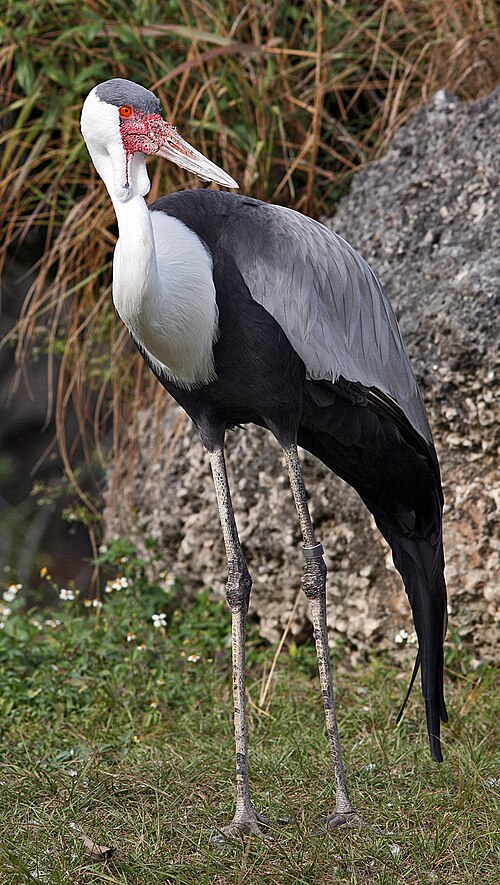 Wattled CraneGrus carunculataAt a height known to range from 150 to 175 cm (4 ft 11 in to 5 ft 9 in), it is the largest crane in Africa and is the second tallest species of crane in the world, after the sarus crane.
Side by side: Blue Crane vs Common Crane · Blue Crane vs Whooping Crane · Blue Crane vs Demoiselle Crane · Blue Crane vs Wattled Crane
Learn the Blue Crane in the BeakBrain App
Photo and call practice. Coming soon to iPhone and Android.
Play today's Daily BirdEvery photo and recording on this page is credited to its author under the licence shown. Spotted a problem with this page, or have a better photo? Contribute.