Learn what every symbol on the card means.Full credits and sources at beakbrain.com/symbols
 ForestCup nestTiny · 10 g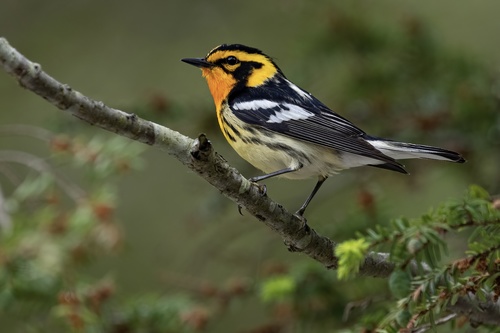


What the Blackburnian Warbler sounds like


ID tip
Blackburnian warblers are small passerines and average-sized wood-warblers. They measure around 11 to 13 cm (4.3 to 5.1 in) long, with a 20 to 22 cm (7.9 to 8.7 in) wingspan, and weigh 8 to 13 g (0.28 to 0.46 oz). The average mass of an adult bird is 9.7 g (0.34 oz), although is slightly higher in fall due to fat reserves, averaging 10.2–10.4 g (0.36–0.37 oz). Among standard measurements, the wing chord is 6.3 to 7.3 cm (2.5 to 2.9 in), the tail is 4.2 to 5 cm (1.7 to 2.0 in), the bill is 0.9 to 1 cm (0.35 to 0.39 in) and the tarsus is 1.6 to 1.8 cm (0.63 to 0.71 in).
Text from Wikipedia, licensed CC BY-SA 4.0.
When to see the Blackburnian Warbler
One bar for each month. Filled bars are the 6 months with records; pale bars are months with none. The wide bar is May, the month with the most records.
Where to see the Blackburnian Warbler
The map shades 32 countries with regular records, and 4 more in a lighter tone where the bird turns up only as a stray. Everything unshaded has no records. Countries are listed below the map.
Recorded as a rare visitor in United Kingdom, Portugal, U.S. Virgin Islands, Barbados.
About the Blackburnian Warbler
The Blackburnian warbler is a small New World warbler. They breed in eastern North America, from southern Canada, westwards to the southern Canadian Prairies, the Great Lakes region and New England, to North Carolina. They are migratory, wintering in southern Central America and South America, and are very rare vagrants to western Europe. The common name honors the English botanist Anna Blackburne.
Text adapted from Wikipedia, licensed CC BY-SA 4.0.
Easily confused with
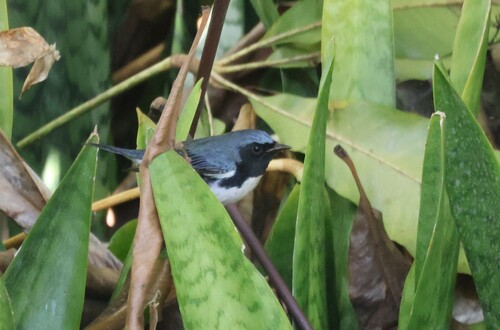 Black-throated Blue WarblerSetophaga caerulescensThe black-throated blue warbler measures 13 cm (5.1 in) in length and weighs 8.4–12.4 g (0.30–0.44 oz).
 Blackpoll WarblerSetophaga striataThe blackpoll warbler is a fairly small bird which attains the weight of a ballpoint pen.
 Yellow-throated WarblerSetophaga dominicaThe yellow-throated warbler is 13–14 cm (5.1–5.5 in) long, with a wingspan of 21 cm (8.3 in), and weighs 8.5–11.3 g (0.30–0.40 oz).
Side by side: Blackburnian Warbler vs Magnolia Warbler · Blackburnian Warbler vs Chestnut-sided Warbler · Black-throated Blue Warbler vs Blackburnian Warbler · Blackburnian Warbler vs Blackpoll Warbler · Blackburnian Warbler vs Yellow-throated Warbler
Learn the Blackburnian Warbler in the BeakBrain App
Photo and call practice. Coming soon to iPhone and Android.
Play today's Daily BirdEvery photo and recording on this page is credited to its author under the licence shown. Spotted a problem with this page, or have a better photo? Contribute.