Learn what every symbol on the card means.Full credits and sources at beakbrain.com/symbols
 ForestCup nestTiny · 10 g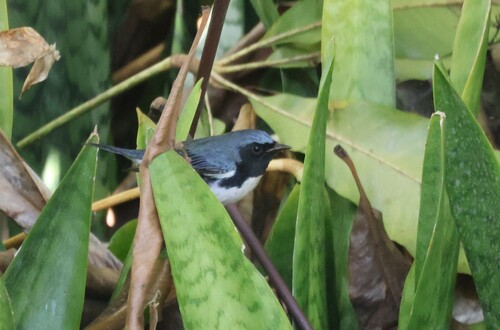


What the Black-throated Blue Warbler sounds like


ID tip
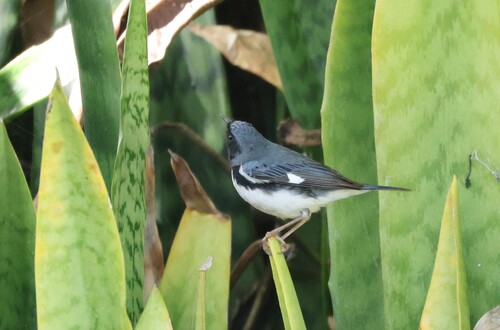
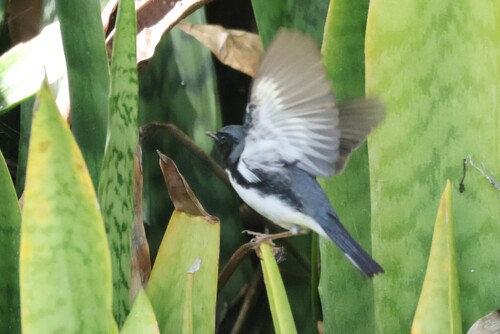
The black-throated blue warbler measures 13 cm (5.1 in) in length and weighs 8.4–12.4 g (0.30–0.44 oz). Wingspan ranges from 7.5–7.9 in (19–20 cm). This is a strongly sexually dimorphic bird. The adult male has white underparts with a black throat, face and flanks. The upperparts are deep blue. The immature male is similar, but with greener upperparts. The female has olive-brown upperparts and light yellow underparts with darker wings and tail, gray crown and brown patches on the cheek. Both sexes have a thin pointed bill and small white wing patches which are not always visible.
Text from Wikipedia, licensed CC BY-SA 4.0.
When to see the Black-throated Blue Warbler
One bar for each month. Filled bars are the 6 months with records; pale bars are months with none. The wide bar is May, the month with the most records.
Where to see the Black-throated Blue Warbler
The map shades 29 countries with regular records, and 5 more in a lighter tone where the bird turns up only as a stray. Everything unshaded has no records. Countries are listed below the map.
Recorded as a rare visitor in Portugal, Iceland, Dominica, Ecuador, St. Barthélemy.
About the Black-throated Blue Warbler
The black-throated blue warbler is a small passerine bird of the New World warbler family. Its breeding ranges are located in the interior of deciduous and mixed coniferous forests in eastern North America. Over the cooler months, it migrates to islands in the Caribbean and Central America. It is very rarely found in western Europe, where it is considered to be a non-indigenous species. The black-throated blue warbler is sexually dimorphic; the adult male has a black face and cheeks, deep blue upperparts and white underparts, while the adult female is olive-brown above and light yellow below.
Text adapted from Wikipedia, licensed CC BY-SA 4.0.
Easily confused with
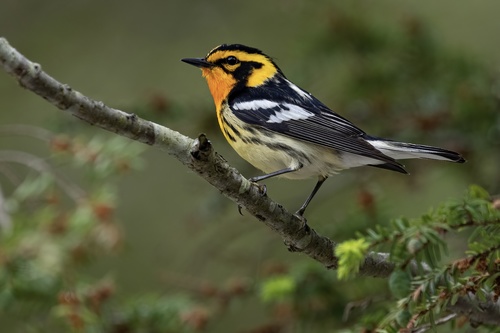 Blackburnian WarblerSetophaga fuscaBlackburnian warblers are small passerines and average-sized wood-warblers.
 Blackpoll WarblerSetophaga striataThe blackpoll warbler is a fairly small bird which attains the weight of a ballpoint pen.
 Yellow-throated WarblerSetophaga dominicaThe yellow-throated warbler is 13–14 cm (5.1–5.5 in) long, with a wingspan of 21 cm (8.3 in), and weighs 8.5–11.3 g (0.30–0.40 oz).
Side by side: Black-throated Blue Warbler vs Blackburnian Warbler · Black-throated Blue Warbler vs Blackpoll Warbler · Black-throated Blue Warbler vs Yellow-throated Warbler
Learn the Black-throated Blue Warbler in the BeakBrain App
Photo and call practice. Coming soon to iPhone and Android.
Play today's Daily BirdEvery photo and recording on this page is credited to its author under the licence shown. Spotted a problem with this page, or have a better photo? Contribute.