Learn what every symbol on the card means.Full credits and sources at beakbrain.com/symbols
 WetlandPlatform nestMedium · 177 g




What the Black-winged Stilt sounds like


ID tip
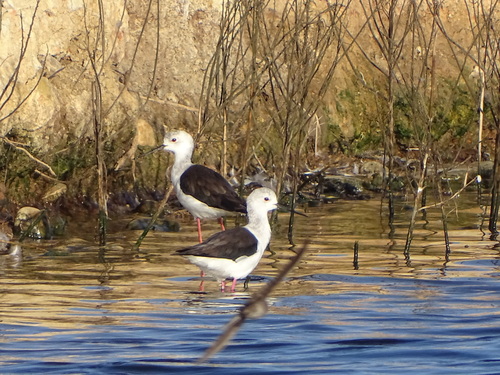
Adults are 33–36 cm (13–14 in) long, with long, pink legs, and a long, rather thin black bill. The birds are generally black above and white below, with a white head and neck (with a varying amount of black, species-dependent). Males have a black back, often with a greenish gloss or sheen. Females' backs have a brownish hue, contrasting with the black remiges. In populations where the top of the head is normally white (at least in winter), females tend to have less black on the head and neck the entire year-round, while males often have much more black, particularly in summer.
Text from Wikipedia, licensed CC BY-SA 4.0.
When to see the Black-winged Stilt
One bar for each month, and every month is filled: this bird is recorded here in all twelve. The wide bar is April, the month with the most records.
Where to see the Black-winged Stilt
The map shades 140 countries with regular records, and 11 more in a lighter tone where the bird turns up only as a stray. Everything unshaded has no records. Countries are listed below the map.
Recorded as a rare visitor in Finland, United States, New Zealand, Brazil, Cuba, Argentina, Colombia, French Guiana, St. Barthélemy, St. Martin, Jersey.
About the Black-winged Stilt
The black-winged stilt is a widely distributed, very long-legged wader in the avocet and stilt family Recurvirostridae. Its scientific name, Himantopus himantopus, is sometimes used to generalize a single, almost cosmopolitan species. Alternatively, it is restricted to the form that is widespread in Europe, Asia and Africa, which equals the nominate group of H. himantopus sensu lato. Meanwhile, the black-necked and white-backed stilts both inhabit the Americas; the pied stilt ranges from Australia and New Zealand. Today, most sources accept between one and four actual species.
Text adapted from Wikipedia, licensed CC BY-SA 4.0.
Easily confused with
 Black-necked StiltHimantopus mexicanusMeasurements:
Length: 13.8–15.3 in (35–39 cm)
Weight: 5.3–6.2 oz (150–180 g)
Wingspan: 28.1–29.7 in (71–75 cm)
They have long pink legs and a long thin black bill.
Black-necked StiltHimantopus mexicanusMeasurements:
Length: 13.8–15.3 in (35–39 cm)
Weight: 5.3–6.2 oz (150–180 g)
Wingspan: 28.1–29.7 in (71–75 cm)
They have long pink legs and a long thin black bill.
 Pied StiltHimantopus leucocephalusThe pied stilt grows to a length of about 14 in (36 cm) with a wingspan of about 26.5 in (67 cm).
 Black StiltHimantopus novaezelandiaeBlack stilts are a medium-sized (220 g) wader with extremely long pink legs, red eyes, distinctively black plumage, and a long slender black bill.
Side by side: Black-necked Stilt vs Black-winged Stilt · Black-winged Stilt vs Pied Stilt
Learn the Black-winged Stilt in the BeakBrain App
Photo and call practice. Coming soon to iPhone and Android.
Play today's Daily BirdEvery photo and recording on this page is credited to its author under the licence shown. Spotted a problem with this page, or have a better photo? Contribute.