Learn what every symbol on the card means.Full credits and sources at beakbrain.com/symbols
 CoastalMedium · 177 g



What the Black-necked Stilt sounds like


ID tip
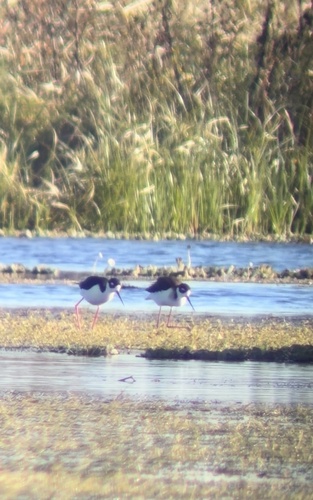
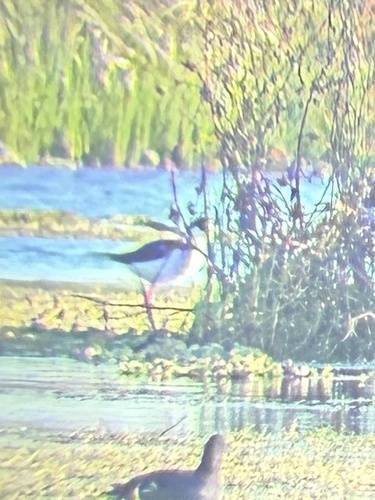
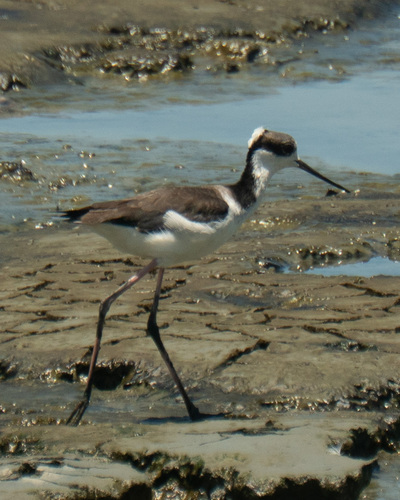
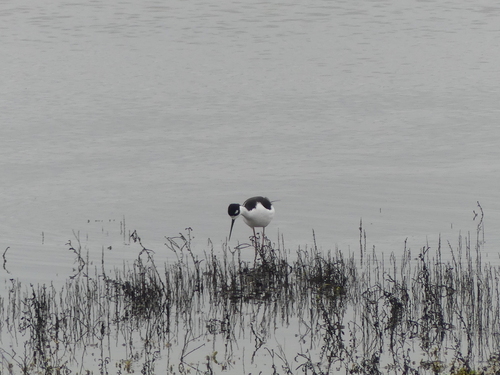
Measurements: Length: 13.8–15.3 in (35–39 cm) Weight: 5.3–6.2 oz (150–180 g) Wingspan: 28.1–29.7 in (71–75 cm) They have long pink legs and a long thin black bill. They are white below and have black wings and backs. The tail is white with some grey banding. A continuous area of black extends from the back along the hind neck to the head. There, it forms a cap covering the entire head from the top to just below eye-level, with the exception of the areas surrounding the bill and a small white spot above the eye.
Text from Wikipedia, licensed CC BY-SA 4.0.
When to see the Black-necked Stilt
One bar for each month, and every month is filled: this bird is recorded here in all twelve. The wide bar is April, the month with the most records.
Where to see the Black-necked Stilt
The map shades 50 countries with regular records, and 3 more in a lighter tone where the bird turns up only as a stray. Everything unshaded has no records. Countries are listed below the map.
About the Black-necked Stilt
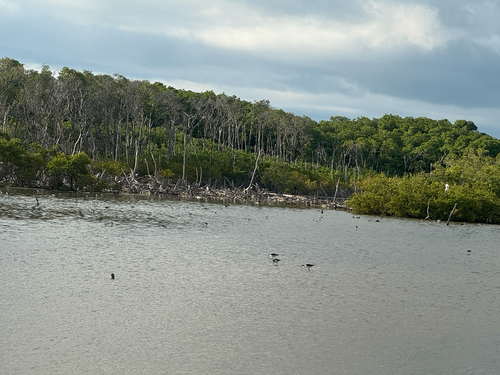
The black-necked stilt, also called the pied stilt, is a locally abundant shorebird of North and South American wetlands and coastlines. It is found from the coastal areas of California through much of the interior western United States and along the Gulf of Mexico as far east as Florida, then south through Central America and the Caribbean to Brazil, Peru and the Galápagos Islands, with an isolated population, the Hawaiian stilt, in Hawaii.
Text adapted from Wikipedia, licensed CC BY-SA 4.0.
Easily confused with
 Black-winged StiltHimantopus himantopusAdults are 33–36 cm (13–14 in) long, with long, pink legs, and a long, rather thin black bill.
 Pied StiltHimantopus leucocephalusThe pied stilt grows to a length of about 14 in (36 cm) with a wingspan of about 26.5 in (67 cm).
 Black StiltHimantopus novaezelandiaeBlack stilts are a medium-sized (220 g) wader with extremely long pink legs, red eyes, distinctively black plumage, and a long slender black bill.
Side by side: Black-necked Stilt vs Black-winged Stilt · Black-necked Stilt vs Pied Stilt
Learn the Black-necked Stilt in the BeakBrain App
Photo and call practice. Coming soon to iPhone and Android.
Play today's Daily BirdEvery photo and recording on this page is credited to its author under the licence shown. Spotted a problem with this page, or have a better photo? Contribute.