Learn what every symbol on the card means.Full credits and sources at beakbrain.com/symbols
 WetlandPlatform nestHuge · 4.7 kg


ID tip
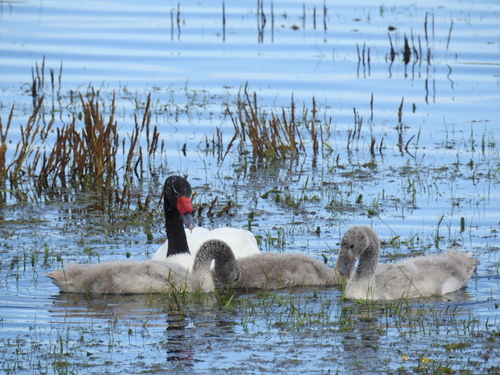
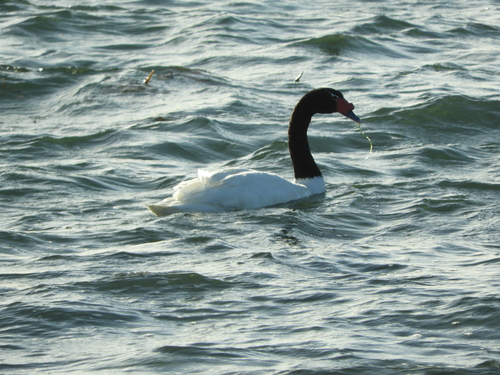
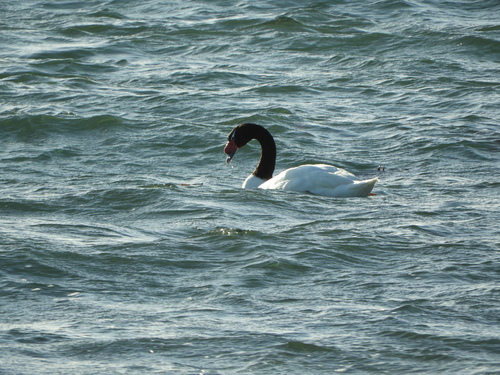
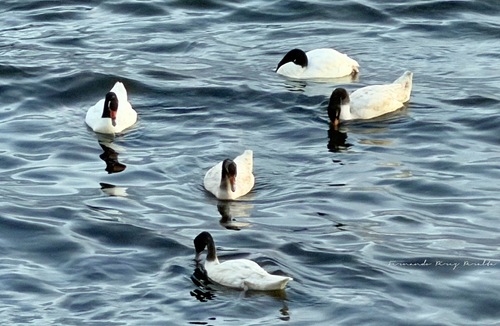
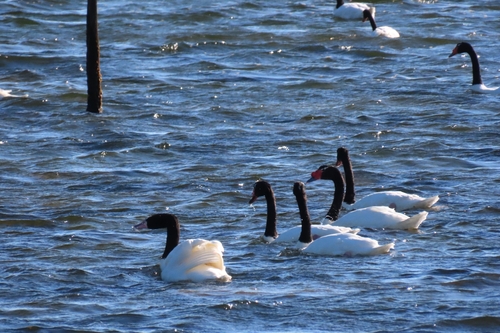
The black-necked swan is the only member of its genus that breeds in the neotropics and is the largest waterfowl native to South America. Adults are 102 to 124 cm (40 to 49 in) long with a wingspan of 135 to 177 cm (53 to 70 in). Males weigh 4.6 to 8.7 kg (10 to 19 lb) and females 3.5 to 4.4 kg (7.7 to 9.7 lb). The sexes are alike. Adults' body plumage is white and the neck and head black; the latter usually has a white stripe behind the eye. They have a prominent red knob at the base of their bill. Juveniles are grayish rather than white and lack the knob until their third or fourth year. Voice: The black-necked swan is mostly silent outside the breeding season. During that time, both sexes give a "soft, musical 'Whee-whee-whee' with the accent on the initial syllable", repeating it to challenge intruders. The call is also used to maintain contact between members of a pair. Males also give "a musical 'hooee-hoo-hoo'."
Text from Wikipedia, licensed CC BY-SA 4.0.
When to see the Black-necked Swan
One bar for each month, and every month is filled: this bird is recorded here in all twelve. The wide bar is October, the month with the most records.
Where to see the Black-necked Swan
The map shades 7 countries with regular records, and 6 more in a lighter tone where the bird turns up only as a stray. Everything unshaded has no records. Countries are listed below the map.
Recorded as a rare visitor in United States, Netherlands, Germany, United Kingdom, France, Belgium.
About the Black-necked Swan
The black-necked swan is a species of waterfowl in the tribe Cygnini of the subfamily Anserinae. It is found in Argentina, Brazil, Chile, Uruguay, and the Falkland Islands.
Text adapted from Wikipedia, licensed CC BY-SA 4.0.
Easily confused with
 Black SwanCygnus atratusBlack swans are black-feathered birds, with white flight feathers.
 Tundra SwanCygnus columbianusC. columbianus is the smallest of the Holarctic swans, at 115–150 cm (45–59 in) in length, 168–211 cm (66–83 in) in wingspan and a weight range of 3.4–9.6 kg (7.5–21.2 lb).
 Trumpeter SwanCygnus buccinatorThe trumpeter swan is the largest extant species of waterfowl, and both the heaviest and longest native bird of North America.
Side by side: Black-necked Swan vs Black Swan · Black-necked Swan vs Tundra Swan · Black-necked Swan vs Trumpeter Swan
Learn the Black-necked Swan in the BeakBrain App
Photo and call practice. Coming soon to iPhone and Android.
Play today's Daily BirdEvery photo and recording on this page is credited to its author under the licence shown. Spotted a problem with this page, or have a better photo? Contribute.