Learn what every symbol on the card means.Full credits and sources at beakbrain.com/symbols
 WetlandLarge · 538 g


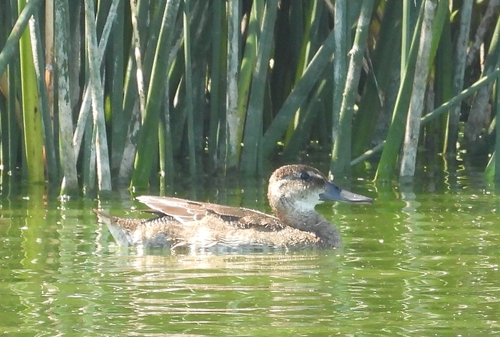
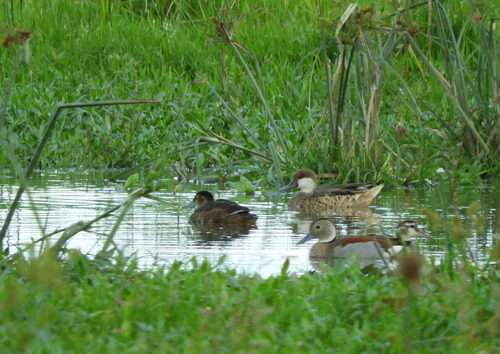
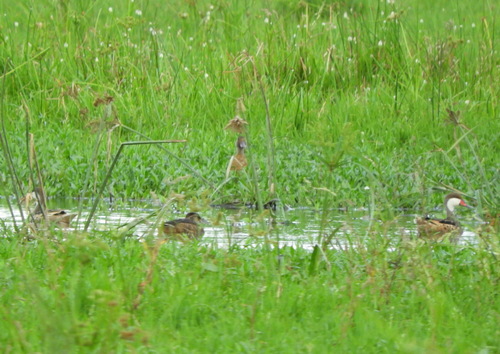


ID tip
The black-headed duck is the most basal living member of its subfamily, and it lacks the stiff tail and swollen bill of its relatives. Overall much resembling a fairly typical diving duck, its plumage and other peculiarities indicate it may not be a very close relative of the other stiff-tailed ducks, but rather the product of convergent evolution from the ancestors of the stiff-tailed ducks. The black-headed duck is about 35 cm (14 in) long. Males weigh an average of about 510 g (18 oz) and females 565 g (20 oz). Voice: The black-headed duck is usually silent. It does give a low "quah quah" as part of a courtship display, and also "a two note grunt followed by a whistle: – gr-rump-freet." Females make "clucking notes."
Text from Wikipedia, licensed CC BY-SA 4.0.
When to see the Black-headed Duck
One bar for each month, and every month is filled: this bird is recorded here in all twelve. The wide bar is October, the month with the most records.
Where to see the Black-headed Duck
The map shades 6 countries with regular records. Everything unshaded has no records. Countries are listed below the map.
About the Black-headed Duck
The black-headed duck is a South American duck in subfamily Oxyurinae of family Anatidae. It is found in Argentina, Bolivia, Brazil, Chile, Paraguay, and Uruguay.
Text adapted from Wikipedia, licensed CC BY-SA 4.0.
Easily confused with
 West Indian Whistling DuckDendrocygna arboreaThe West Indian whistling duck is the largest and darkest of the whistling ducks with a length of 48 to 58 cm (19 to 23 in).
 Baikal TealSibirionetta formosaThe Baikal teal has a height of 30–40 cm (11.75–15.75 in), and a weighs an average of 500 g (1 lb).
 African Pygmy GooseNettapus auritusThe African pygmy goose is one of the smallest of the perching ducks, and it has the average weight of about 285 grams (10.1 oz) for males and 260 grams (9.2 oz) for females.
Side by side: Black-headed Duck vs West Indian Whistling Duck · Baikal Teal vs Black-headed Duck · African Pygmy Goose vs Black-headed Duck · Black-headed Duck vs Masked Duck
Learn the Black-headed Duck in the BeakBrain App
Photo and call practice. Coming soon to iPhone and Android.
Play today's Daily BirdEvery photo and recording on this page is credited to its author under the licence shown. Spotted a problem with this page, or have a better photo? Contribute.