Learn what every symbol on the card means.Full credits and sources at beakbrain.com/symbols
 WetlandScrapeLarge · 434 g


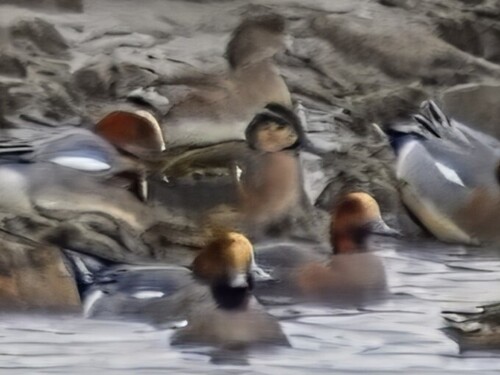
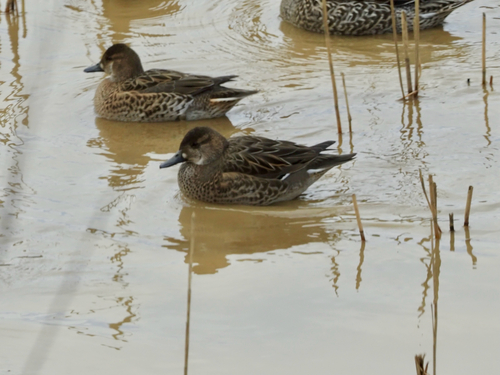


ID tip
The Baikal teal has a height of 30–40 cm (11.75–15.75 in), and a weighs an average of 500 g (1 lb). At a length between 39–43 cm (15–17 in), this duck is slightly larger and longer-tailed than the common teal. The breeding male is unmistakable, with a striking green nape, yellow and black auriculars, neck, and throat. It has a dark crown, and its breast is light brown with dark spots. Its grey sides are set off on the front and rear with white bars.
Text from Wikipedia, licensed CC BY-SA 4.0.
When to see the Baikal Teal
One bar for each month. Filled bars are the 8 months with records; pale bars are months with none. The wide bar is January, the month with the most records.
Where to see the Baikal Teal
The map shades 18 countries with regular records, and 11 more in a lighter tone where the bird turns up only as a stray. Everything unshaded has no records. Countries are listed below the map.
Recorded as a rare visitor in United States, Netherlands, France, Germany, Denmark, Finland, Ireland, Switzerland, Myanmar (Burma), Austria, Greece.
About the Baikal Teal
The Baikal teal, also called the bimaculate duck or squawk duck, is a dabbling duck that breeds in eastern Russia and winters in East Asia.
Text adapted from Wikipedia, licensed CC BY-SA 4.0.
Easily confused with
 African Pygmy GooseNettapus auritusThe African pygmy goose is one of the smallest of the perching ducks, and it has the average weight of about 285 grams (10.1 oz) for males and 260 grams (9.2 oz) for females.
 Masked DuckNomonyx dominicusBreeding adult males have a rust-colored body with a black face and mottled wings.
 Black-headed DuckHeteronetta atricapillaThe black-headed duck is the most basal living member of its subfamily, and it lacks the stiff tail and swollen bill of its relatives.
Side by side: Baikal Teal vs Black-headed Duck · African Pygmy Goose vs Baikal Teal · Baikal Teal vs Masked Duck
Learn the Baikal Teal in the BeakBrain App
Photo and call practice. Coming soon to iPhone and Android.
Play today's Daily BirdEvery photo and recording on this page is credited to its author under the licence shown. Spotted a problem with this page, or have a better photo? Contribute.