Learn what every symbol on the card means.Full credits and sources at beakbrain.com/symbols
 WetlandCup nestMedium · 86 g


What the Black Crake sounds like

ID tip
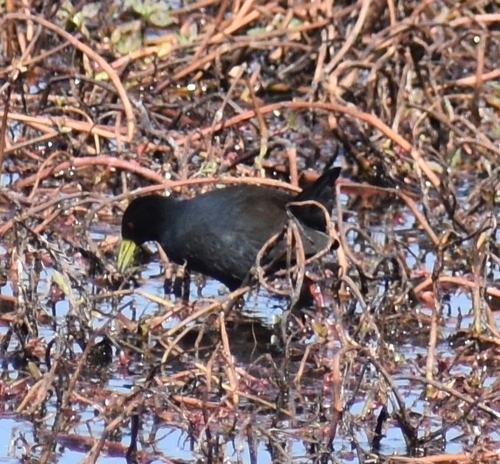
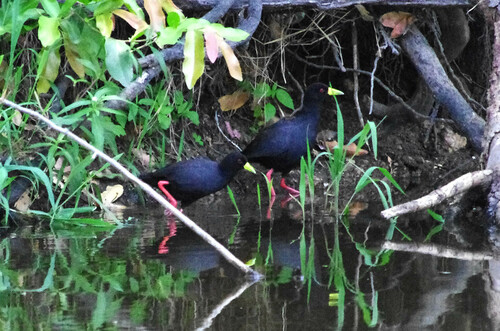
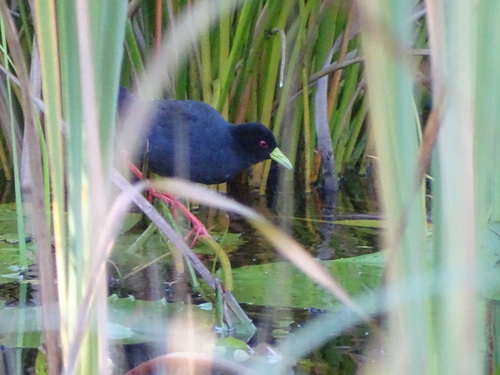
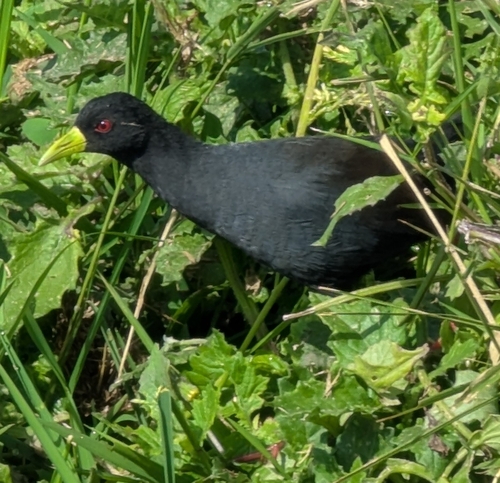
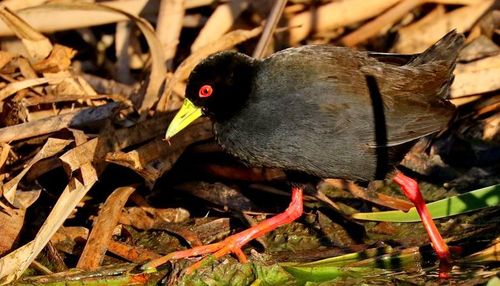
The adult black crake is 19–23 cm (7.5–9.1 in) long with a short tail and long toes. As its name implies, the adult has mainly black plumage, with a brown olive tone on the wings and upperparts which is rarely detectable in the field. The eye is red, the bill is yellow (hence the flavirostra of the binomial name), and the legs and feet are red, duller when not breeding. The sexes are similar, but the male is slightly larger. Most males, but only 10% of females, have a hooked upper mandible. The immature bird has brown upperparts and a dark grey head and underparts.
Text from Wikipedia, licensed CC BY-SA 4.0.
When to see the Black Crake
One bar for each month, and every month is filled: this bird is recorded here in all twelve. The wide bar is November, the month with the most records.
Where to see the Black Crake
The map shades 38 countries with regular records. Everything unshaded has no records. Countries are listed below the map.
About the Black Crake
The black crake is a waterbird in the rail and crake family, Rallidae. It breeds in most of sub-Saharan Africa except in very arid areas. It undertakes some seasonal movements in those parts of its range which are subject to drought. No subspecies have been described. It appears that the oldest available name for this species is actually Rallus niger J. F. Gmelin, 1788, but Swainson believed that the earlier name was unidentifiable, and his own has since become well embedded in the literature.
Text adapted from Wikipedia, licensed CC BY-SA 4.0.
Easily confused with
 Ruddy-breasted CrakeZapornia fuscaThe ruddy-breasted crake, or ruddy crake, is a waterbird in the rail and crake family Rallidae, formerly included in the genus Porzana.
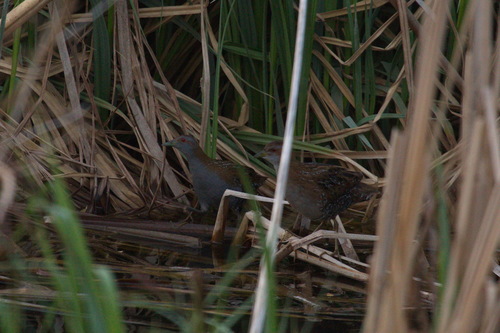 Baillon's CrakeZapornia pusillaThey are 15–18 cm (5.9–7.1 in) in length, and are similar in appearance to the little crake.
 Spotless CrakeZapornia tabuensisAs an adult the spotless crake can reach a length of 17 – 20 cm; a wingspan of 26 – 29 cm; and can weigh between 40 – 50g.
Side by side: Baillon's Crake vs Black Crake · Black Crake vs Spotless Crake
Learn the Black Crake in the BeakBrain App
Photo and call practice. Coming soon to iPhone and Android.
Play today's Daily BirdEvery photo and recording on this page is credited to its author under the licence shown. Spotted a problem with this page, or have a better photo? Contribute.