Learn what every symbol on the card means.Full credits and sources at beakbrain.com/symbols
 WetlandCup nestSmall · 35 g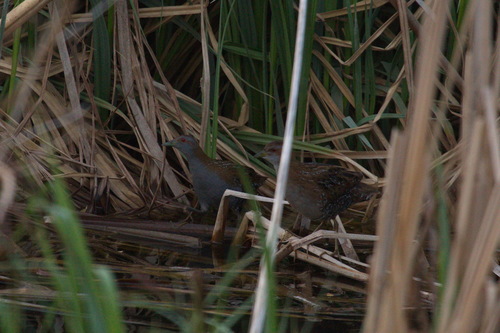
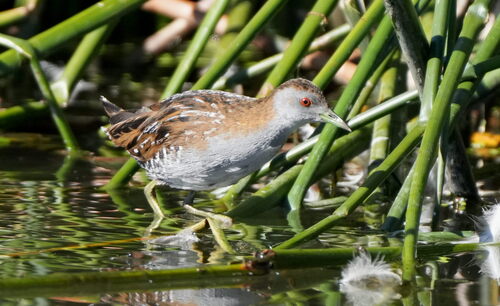
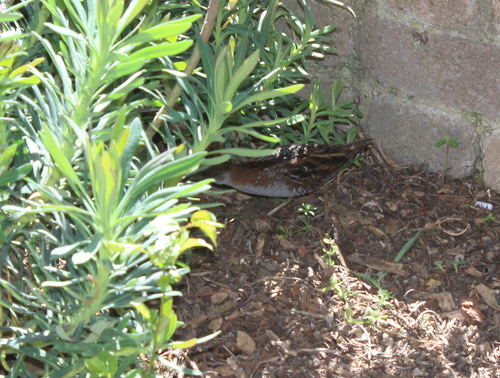
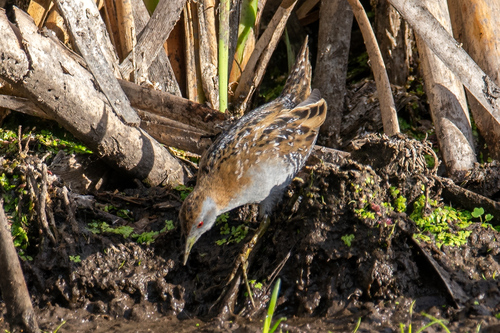
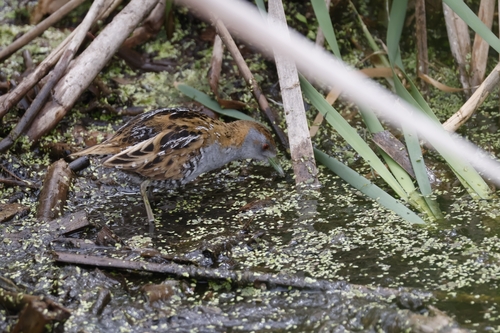
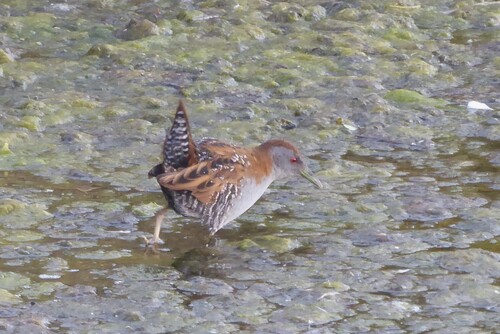
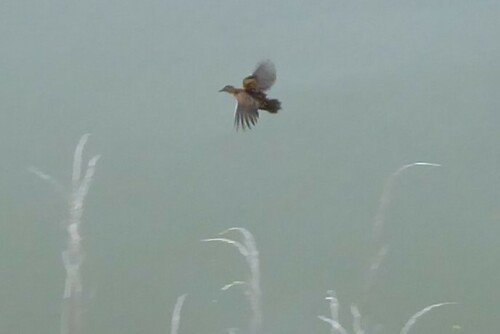
What the Baillon's Crake sounds like


ID tip
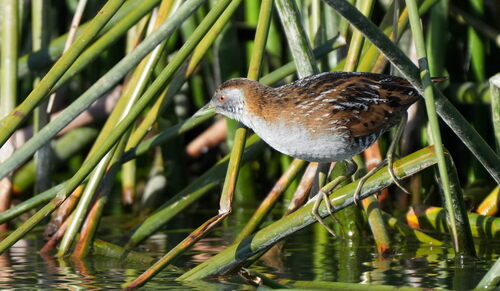
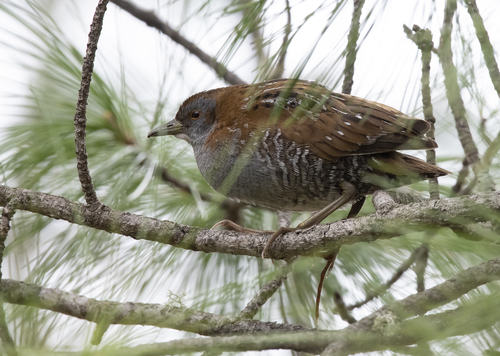
They are 15–18 cm (5.9–7.1 in) in length, and are similar in appearance to the little crake. Baillon's crake has a short straight bill, yellow or green without a red base. Adults have mainly ochre-brown upperparts streaked through occasionally with black and white markings. Their underparts are a light blue-grey, paler on the throat, breast and abdomen. The flanks and under-tail are barred black and white. They have olive-green legs with long toes. Immature Baillon's crakes are similar to the adults, but have extensively barred, duller underparts. The chicks are black, as with all rails.
Text from Wikipedia, licensed CC BY-SA 4.0.
When to see the Baillon's Crake
One bar for each month. Filled bars are the 9 months with records; pale bars are months with none. The wide bar is January, the month with the most records.
Where to see the Baillon's Crake
The map shades 62 countries with regular records, and 22 more in a lighter tone where the bird turns up only as a stray. Everything unshaded has no records. Countries are listed below the map.
Recorded as a rare visitor in United Kingdom, Netherlands, Germany, Portugal, Finland, Morocco, Poland, Mauritania, Czechia, Serbia, Egypt, Iran, Kyrgyzstan, Qatar, Ireland, Eswatini, Rwanda, United States, Saudi Arabia, Luxembourg, Slovakia, Papua New Guinea.
About the Baillon's Crake
Baillon's crake, also known as the marsh crake, is a small waterbird of the family Rallidae.
Text adapted from Wikipedia, licensed CC BY-SA 4.0.
Easily confused with
 Ruddy-breasted CrakeZapornia fuscaThe ruddy-breasted crake, or ruddy crake, is a waterbird in the rail and crake family Rallidae, formerly included in the genus Porzana.
 Spotless CrakeZapornia tabuensisAs an adult the spotless crake can reach a length of 17 – 20 cm; a wingspan of 26 – 29 cm; and can weigh between 40 – 50g.
 Little CrakeZapornia parvaThe little crake is a very small waterbird of the family Rallidae. parva is Latin for "small".
Side by side: Baillon's Crake vs Black Crake · Baillon's Crake vs Spotless Crake
Learn the Baillon's Crake in the BeakBrain App
Photo and call practice. Coming soon to iPhone and Android.
Play today's Daily BirdEvery photo and recording on this page is credited to its author under the licence shown. Spotted a problem with this page, or have a better photo? Contribute.