Learn what every symbol on the card means.Full credits and sources at beakbrain.com/symbols
 ForestCup nestTiny · 11 g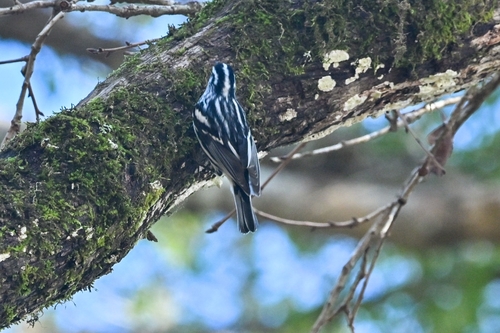


What the Black-and-white Warbler sounds like


ID tip
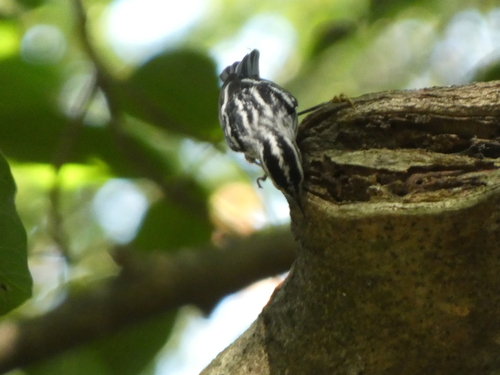
The black-and-white warbler is 11 cm (4.3 in) to 13 cm (5.1 in) in length with a mass of 8 g (0.28 oz) to 15 g (0.53 oz) grams. Wingspan ranges from 7.1 to 8.7 in (18–22 cm). True to their name, black-and-white warblers are black and white in colour. Both sexes have black and white crowns with a white eyebrow, black streaking on a white belly, black wings with two white wing bars, a black tail, a black-and-white streaked back, streaky undertail coverts, and grey-black legs and feet. Voice: The black-and-white warbler has a high-pitched song, described as a repeating wee-see that is repeated at least six times in succession. It has a chip call as well as a seet-seet call that is sometimes given in flight. Its song is a high see wee-see wee-see wee-see wee-see wee-see or weesa weesa weetee weetee weetee weet weet weet. It has two calls, a hard tick and a soft, thin fsss.
Text from Wikipedia, licensed CC BY-SA 4.0.
When to see the Black-and-white Warbler
One bar for each month. Filled bars are the 7 months with records; pale bars are months with none. The wide bar is May, the month with the most records.
Where to see the Black-and-white Warbler
The map shades 38 countries with regular records, and 10 more in a lighter tone where the bird turns up only as a stray. Everything unshaded has no records. Countries are listed below the map.
Recorded as a rare visitor in United Kingdom, Spain, Portugal, Belgium, France, Norway, Ireland, Martinique, Peru, St. Barthélemy.
About the Black-and-white Warbler
The black-and-white warbler is a species of New World warbler, and the only member of its genus, Mniotilta. It breeds in northern and eastern North America and winters in Florida, Central America, and the West Indies down to Peru. It has been recorded as a vagrant in Northern Europe, especially Britain and Ireland. Relative to other New World warblers, it is not well studied.
Text adapted from Wikipedia, licensed CC BY-SA 4.0.
Easily confused with
 Northern ParulaSetophaga americanaThe northern parula is one of the smaller North American migratory warblers, often being one of the smallest birds in a mixed feeding flock besides kinglets or gnatcatchers.
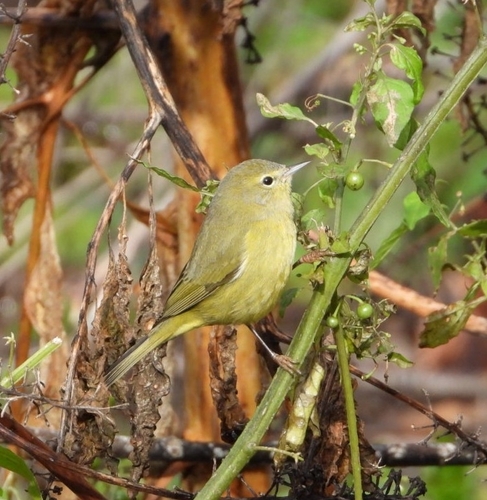 Orange-crowned WarblerLeiothlypis celataThe orange-crowned warbler has olive-grey upperparts, yellowish underparts with faint streaking and a thin pointed bill.
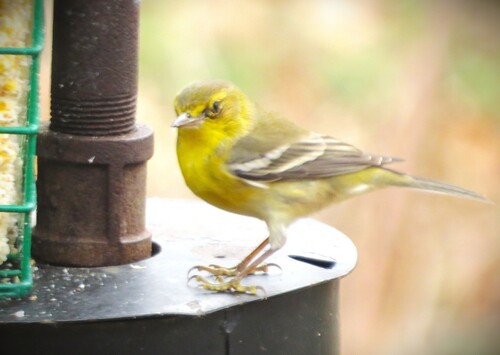 Pine WarblerSetophaga pinusThese birds have white bellies, two white wing bars, dark legs and thin, relatively long pointed bills; they have yellowish 'spectacles' around their eyes.
Side by side: Black-and-white Warbler vs Northern Parula · Black-and-white Warbler vs Orange-crowned Warbler · Black-and-white Warbler vs Pine Warbler
Learn the Black-and-white Warbler in the BeakBrain App
Photo and call practice. Coming soon to iPhone and Android.
Play today's Daily BirdEvery photo and recording on this page is credited to its author under the licence shown. Spotted a problem with this page, or have a better photo? Contribute.