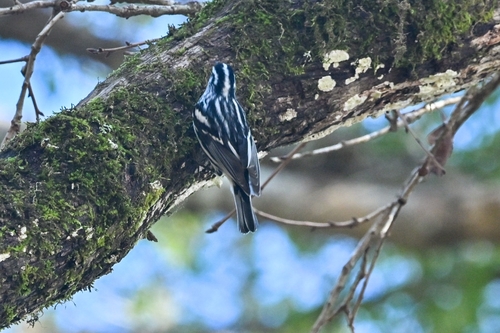
Black-and-white Warbler
Mniotilta varia
The black-and-white warbler is 11 cm (4.3 in) to 13 cm (5.1 in) in length with a mass of 8 g (0.28 oz) to 15 g (0.53 oz) grams. Wingspan ranges from 7.1 to 8.7 in (18–22 cm). True to their name, black-and-white warblers are black and white in colour. Both sexes have black and white crowns with a white eyebrow, black streaking on a white belly, black wings with two white wing bars, a black tail, a black-and-white streaked back, streaky undertail coverts, and grey-black legs and feet. Voice: The black-and-white warbler has a high-pitched song, described as a repeating wee-see that is repeated at least six times in succession. It has a chip call as well as a seet-seet call that is sometimes given in flight. Its song is a high see wee-see wee-see wee-see wee-see wee-see or weesa weesa weetee weetee weetee weet weet weet. It has two calls, a hard tick and a soft, thin fsss.
ID text from Wikipedia, CC BY-SA 4.0

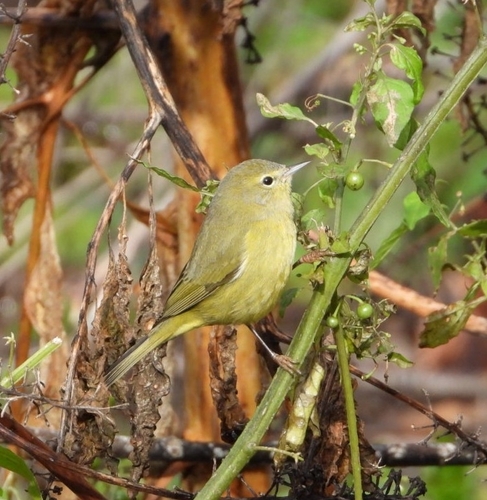
Orange-crowned Warbler
Leiothlypis celata
The orange-crowned warbler has olive-grey upperparts, yellowish underparts with faint streaking and a thin pointed bill. It has a faint line over each eye and a faint broken eye ring. The orange patch on the crown is usually not visible. Females and immatures are duller in colour than males. Western birds are yellower than eastern birds.
ID text from Wikipedia, CC BY-SA 4.0

Where you might meet both
Learn this pair in the BeakBrain App
Photo and call practice. Coming soon to iPhone and Android.
Play today's Daily BirdPhotos and recordings are credited to their authors under the licence shown. Full profiles: Black-and-white Warbler and Orange-crowned Warbler.