Learn what every symbol on the card means.Full credits and sources at beakbrain.com/symbols
 ShrublandCavity nestTiny · 10 g



What the Bewick's Wren sounds like


ID tip
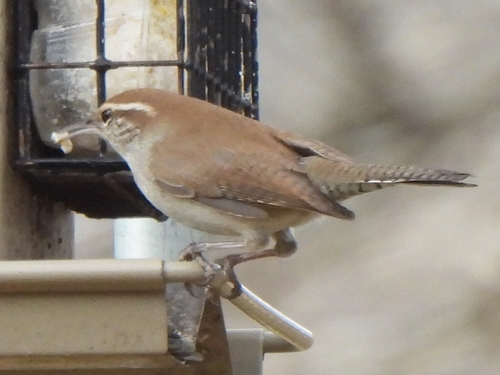
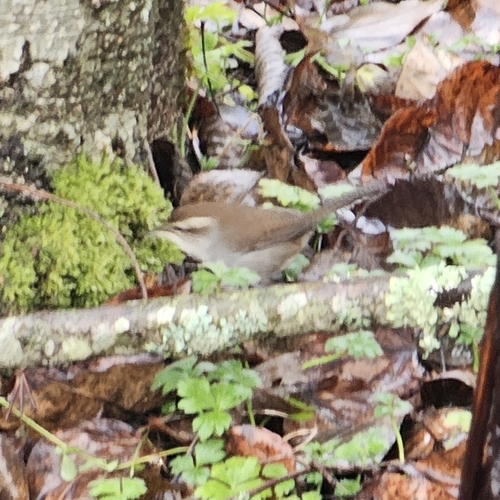
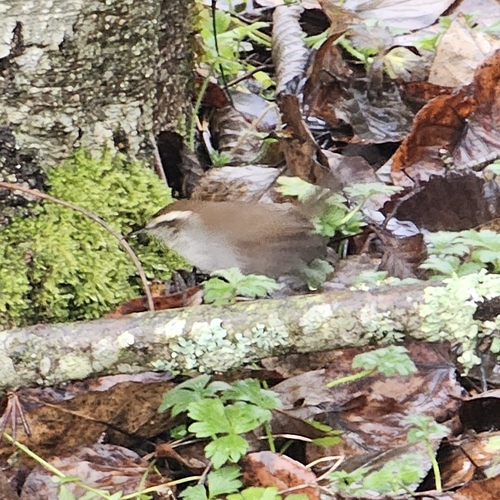
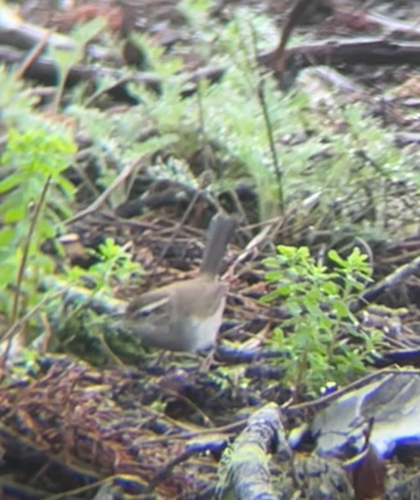
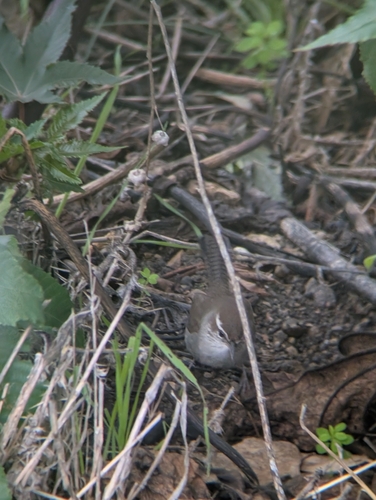
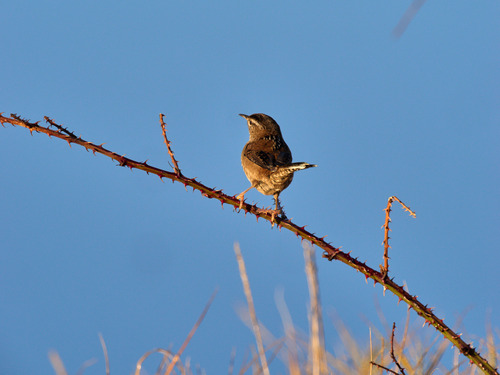
Bewick's wren has an average length of 13 cm (5.1 in) an average weight of 8–12 g (0.28–0.42 oz), and a wingspan of 18 cm (7.1 in). Its plumage is brown on top and light grey underneath, with a white stripe above each eye. Its beak is long, slender, and slightly curved. Its most distinctive feature is its long tail with black bars and white corners. It moves its tail around frequently, making this feature even more obvious for observers. Juveniles look similar to adults, with only a few key differences. Their beaks are usually shorter and stockier. Voice: Bewick's wrens, like many wrens, are very vocal. Both females and males make short calls while foraging and both use a harsh scolding call when agitated. Males also sing in order to attract mates and protect their territory.
Text from Wikipedia, licensed CC BY-SA 4.0.
When to see the Bewick's Wren
One bar for each month, and every month is filled: this bird is recorded here in all twelve. The wide bar is April, the month with the most records.
Where to see the Bewick's Wren
The map shades 3 countries with regular records. Everything unshaded has no records. Countries are listed below the map.
About the Bewick's Wren
Bewick's wren is a wren native to North America. It is the only species placed in the genus Thryomanes. At about 14 cm (5.5 in) long, it is grey-brown above, white below, with a long white eyebrow. While similar in appearance to the Carolina wren, it has a long tail that is tipped in white. The song is loud and melodious, much like the song of other wrens. It lives in thickets, brush piles and hedgerows, open woodlands and scrubby areas, often near streams. It eats insects and spiders, which it gleans from vegetation or finds on the ground.
Text adapted from Wikipedia, licensed CC BY-SA 4.0.
Easily confused with
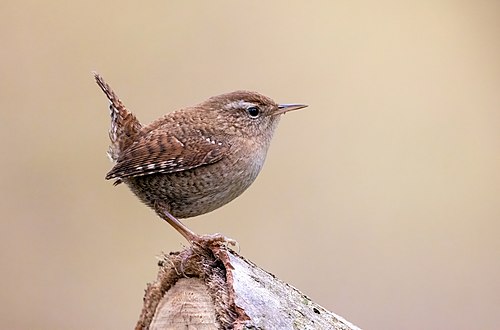 Eurasian WrenTroglodytes troglodytesThe Eurasian wren is a plump, sturdy bird with rounded wings and a short tail, which is usually held cocked up.
 Marsh WrenCistothorus palustrisAdults have brown upperparts with a light brown belly and flanks and a white throat and breast.
 Southern House WrenTroglodytes musculusThe southern house wren is a very small passerine bird in the wren family Troglodytidae.
Side by side: Bewick's Wren vs Carolina Wren · Bewick's Wren vs Eurasian Wren · Bewick's Wren vs Marsh Wren
Learn the Bewick's Wren in the BeakBrain App
Photo and call practice. Coming soon to iPhone and Android.
Play today's Daily BirdEvery photo and recording on this page is credited to its author under the licence shown. Spotted a problem with this page, or have a better photo? Contribute.