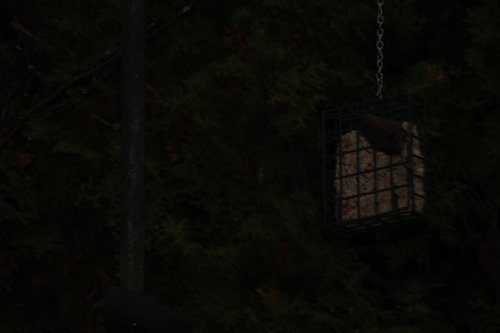
Bewick's Wren
Thryomanes bewickii
Bewick's wren has an average length of 13 cm (5.1 in) an average weight of 8–12 g (0.28–0.42 oz), and a wingspan of 18 cm (7.1 in). Its plumage is brown on top and light grey underneath, with a white stripe above each eye. Its beak is long, slender, and slightly curved. Its most distinctive feature is its long tail with black bars and white corners. It moves its tail around frequently, making this feature even more obvious for observers. Juveniles look similar to adults, with only a few key differences. Their beaks are usually shorter and stockier. Voice: Bewick's wrens, like many wrens, are very vocal. Both females and males make short calls while foraging and both use a harsh scolding call when agitated. Males also sing in order to attract mates and protect their territory.
ID text from Wikipedia, CC BY-SA 4.0

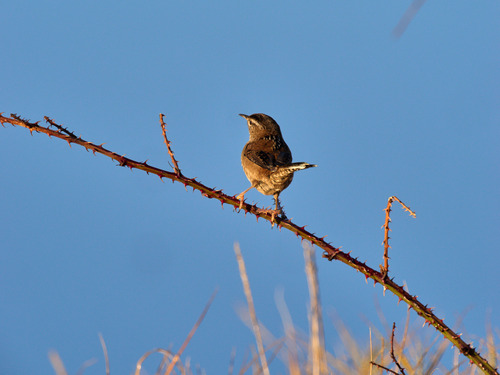
Marsh Wren
Cistothorus palustris
Adults have brown upperparts with a light brown belly and flanks and a white throat and breast. The back is black with white stripes. They have a dark cap with a white line over the eyes and a short thin bill. The male's song is a loud gurgle used to declare ownership of territory; western males have a more varied repertoire. This little bird is native to Canada, Mexico, and the United States. Their breeding habitat is marshes with tall vegetation such as cattails across North America. In the western United States, some birds are permanent residents.
ID text from Wikipedia, CC BY-SA 4.0

Where you might meet both
Learn this pair in the BeakBrain App
Photo and call practice. Coming soon to iPhone and Android.
Play today's Daily BirdPhotos and recordings are credited to their authors under the licence shown. Full profiles: Bewick's Wren and Marsh Wren.